
Public records project
Weston Public Schools DEI Records Project
What a publicly funded DEI Coordinator position was assigned to do, what the public asked to inspect, what access to those records was estimated to cost, and how the Supervisor of Records proceedings handled the dispute.
On July 31, 2026, Parent Data Force asked Weston Public Schools for the first three months of work by its Diversity, Equity, and Inclusion Coordinator. The district answered with a fee estimate of $5,416.67, and two weeks later said it had run no electronic searches to build that estimate. Two appeals, two determinations, and a pending reconsideration followed. No responsive record has been produced. This project assembles the record from the district’s own responses and the Supervisor’s decisions.
What this project evaluates. This is a project about how public tax dollars are used for administrative roles, examined through one publicly funded position as a case study. The position in view — a Diversity, Equity, and Inclusion Coordinator — is exclusively dedicated to DEI, which is exactly what makes it a workable test case: every public dollar behind it funded work only that role would do. This project is not an evaluation of DEI as a policy question and takes no position for or against DEI, its methods, or its conclusions. It asks four narrower questions: what the position was assigned to do, what it was paid to produce, what it actually produced, and what it costs the public to find out.
Last updated: October 1, 2026
What the records establish
- Weston created and funded a Diversity, Equity, and Inclusion Coordinator position held by Shannon Sheldon, whose first three months ran from September 18 through December 18, 2023.
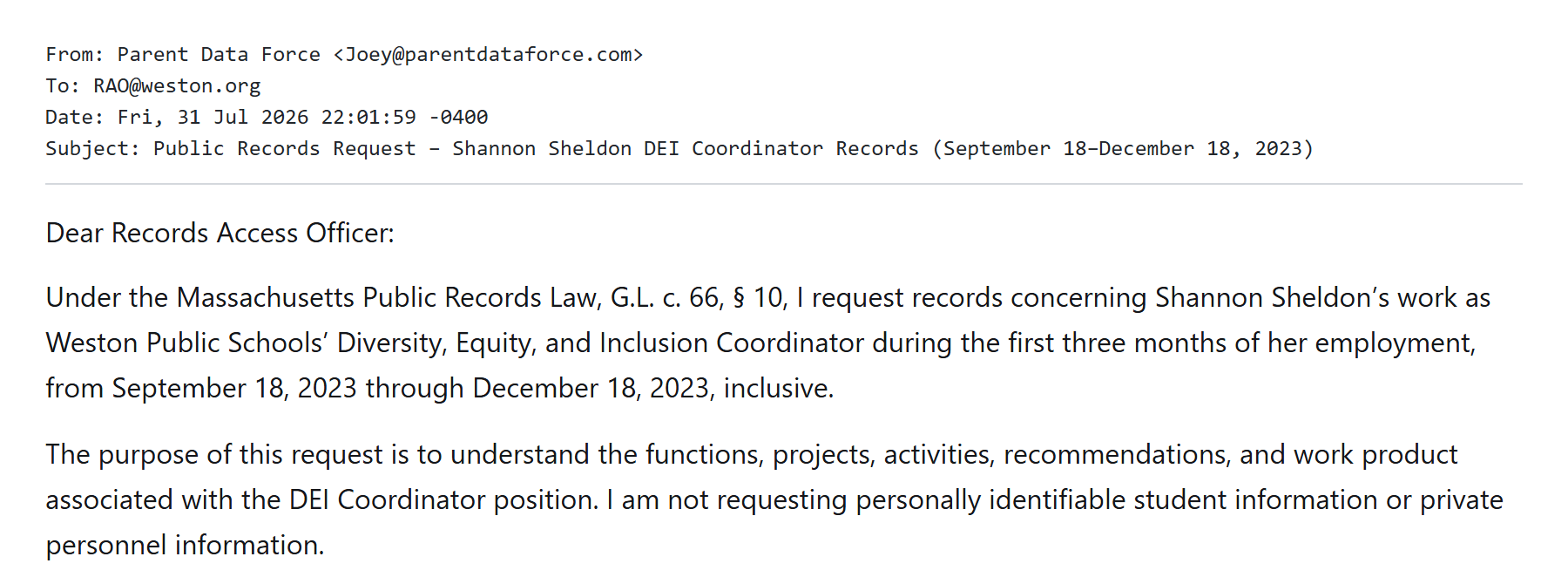
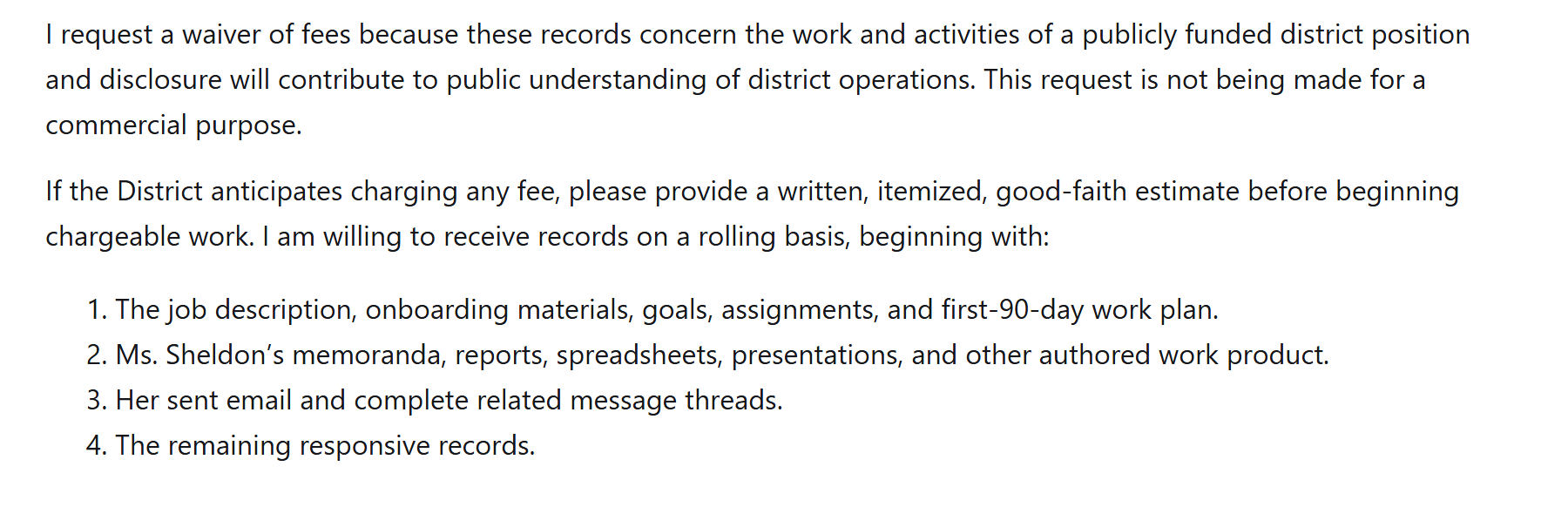
- On July 31, 2026, Parent Data Force submitted a request limited to one named employee, one position, one three-month period and five enumerated record categories, expressly disclaiming student personally identifiable information and private personnel information, and asking for native electronic production with no single flattened PDF portfolio.
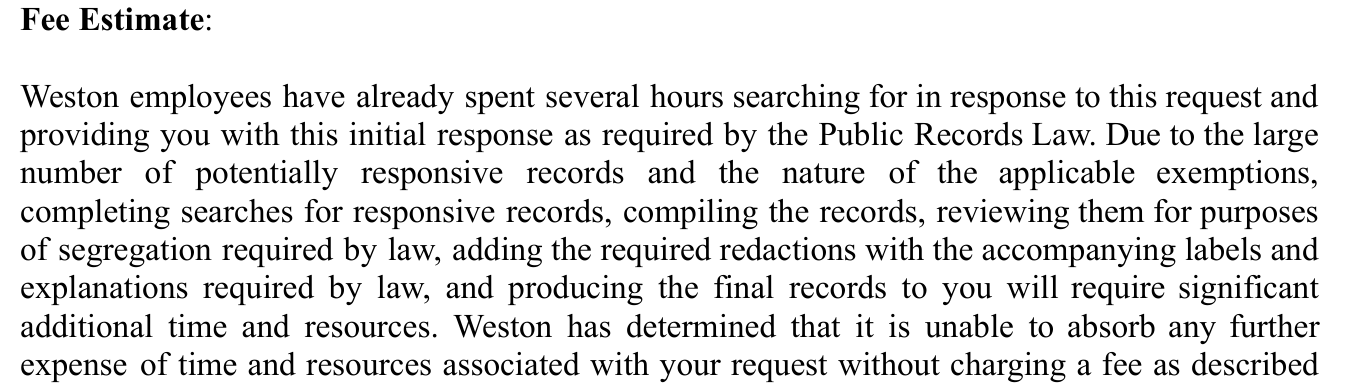
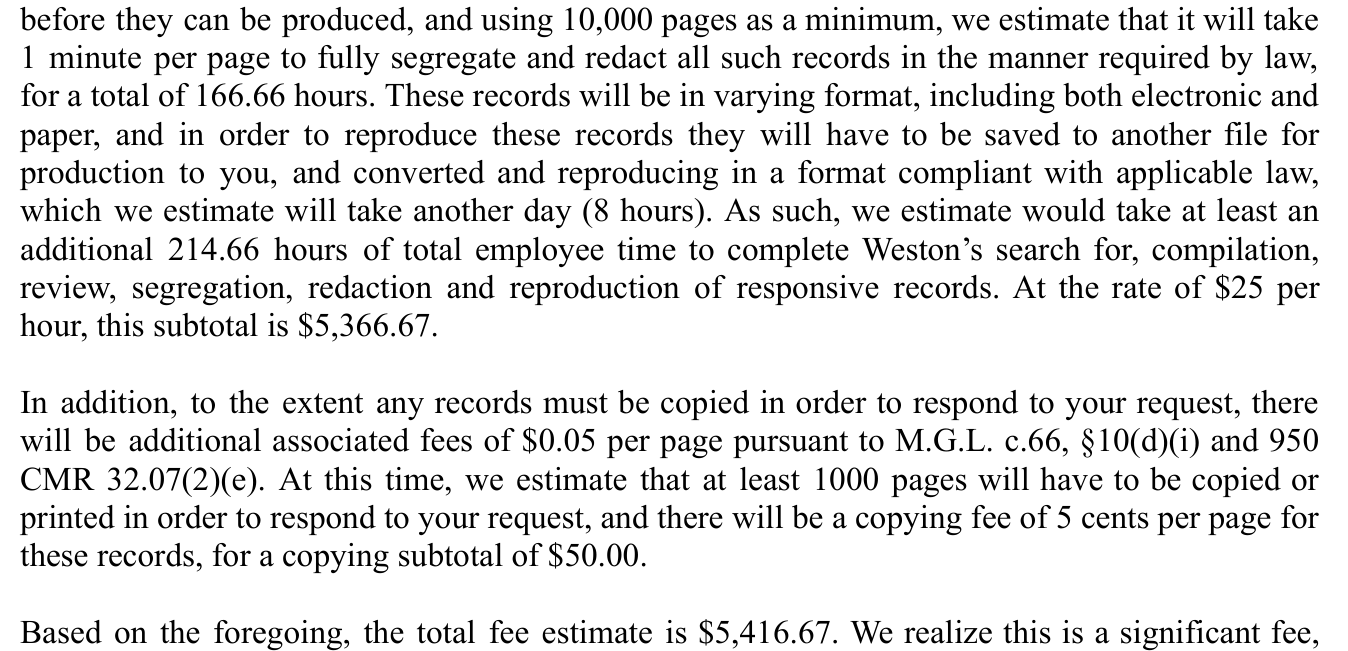
- On August 14, 2026 the district objected to specificity, stated its employees had “already spent several hours searching,” and issued a $5,416.67 fee estimate requiring advance payment, with no production date.
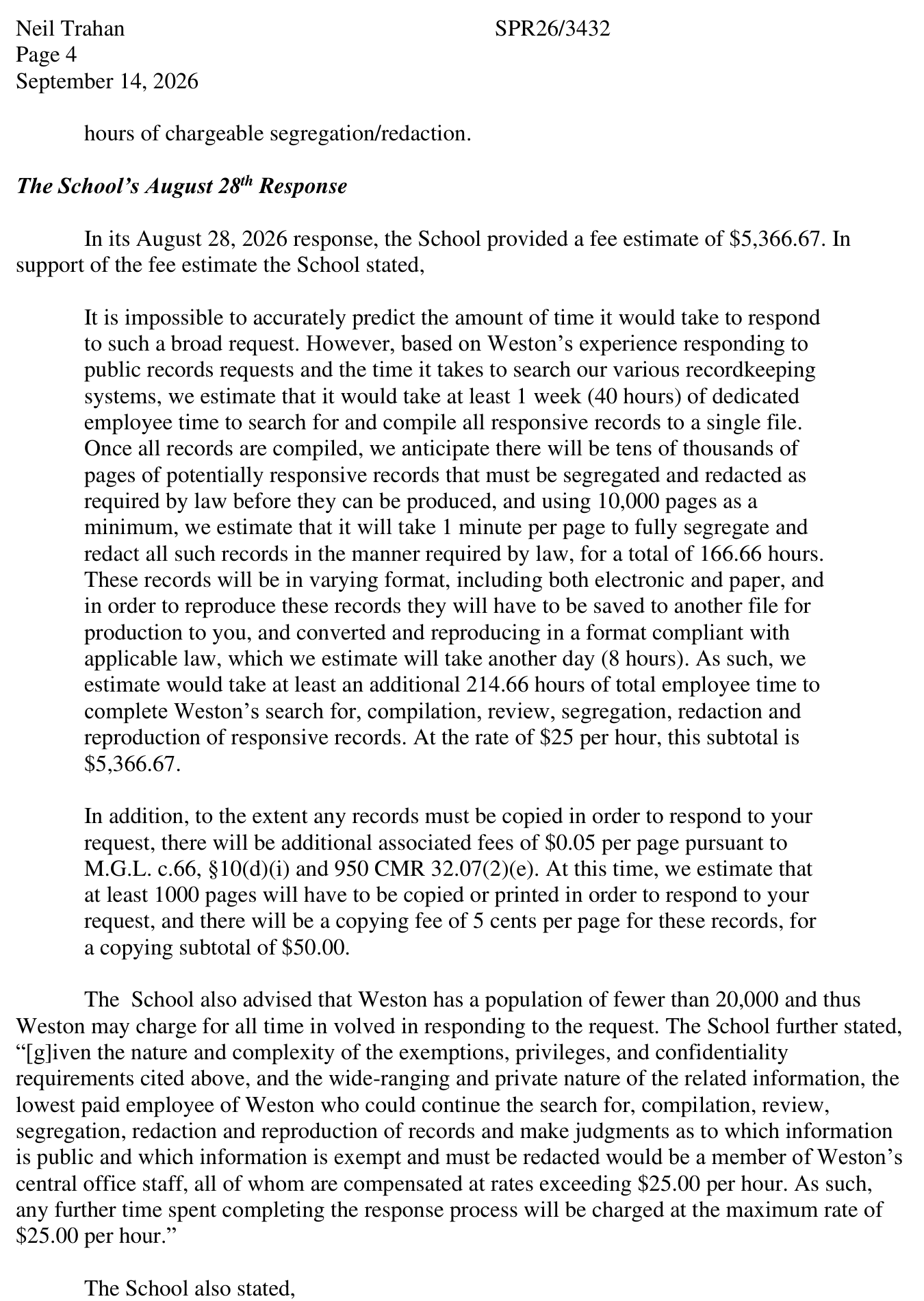
- That estimate was built from 40 search hours, a 10,000-page minimum, 166.66 review hours at one minute per page, 8 conversion hours, and $25 per hour, plus $50 for at least 1,000 copied pages.
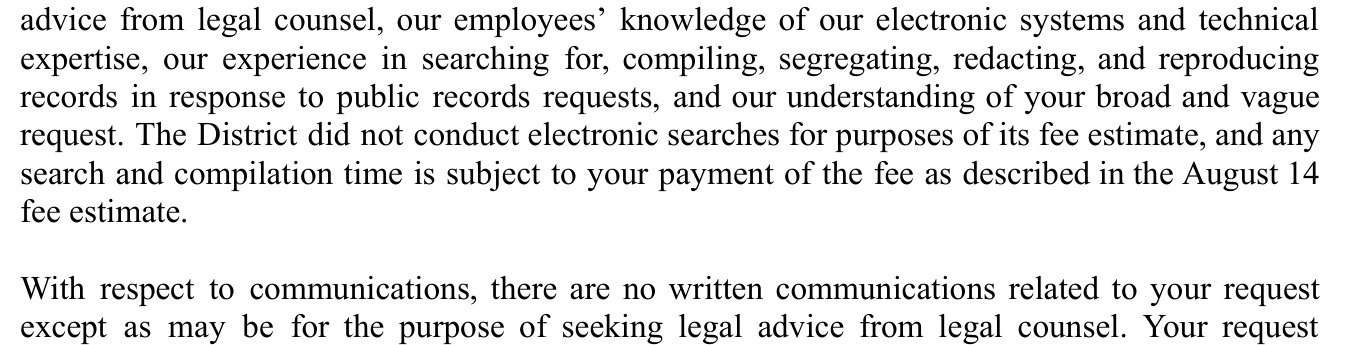
- On August 28, 2026 the district stated: “The District did not conduct electronic searches for purposes of its fee estimate.” It also stated there were no written methodology communications except potentially privileged ones and no versions of the estimate with different figures. It did not withdraw the estimate.
- SPR26/3192 was closed procedurally on August 28 because the district had issued a new response, with the substance of that response preserved for appeal. A supplemental submission at 2:08 p.m. preceded that determination at 2:20 p.m.
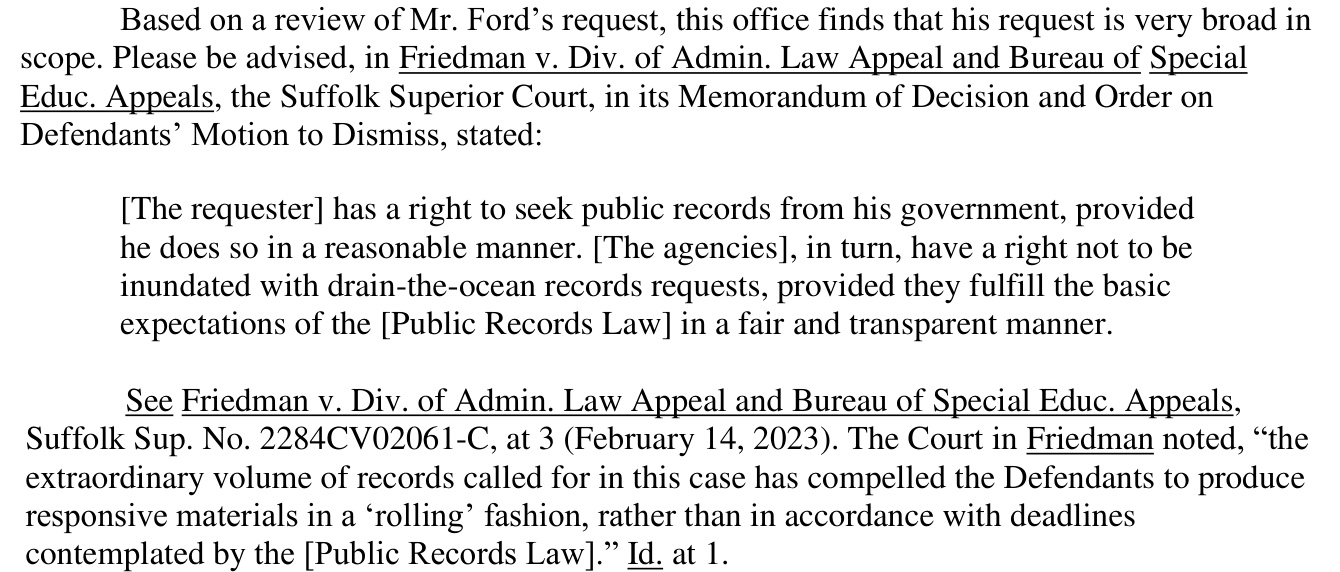
- The September 14, 2026 determination recited the fee rules and both parties’ positions, found the request very broad, quoted *Friedman*, encouraged narrowing, and closed the appeal.
- That determination did not rule that the estimate was lawful, did not establish the 10,000-page or 166.66-hour figures, did not approve the $50 copying charge or the $25 rate, and did not decide the § 10(e) theory.
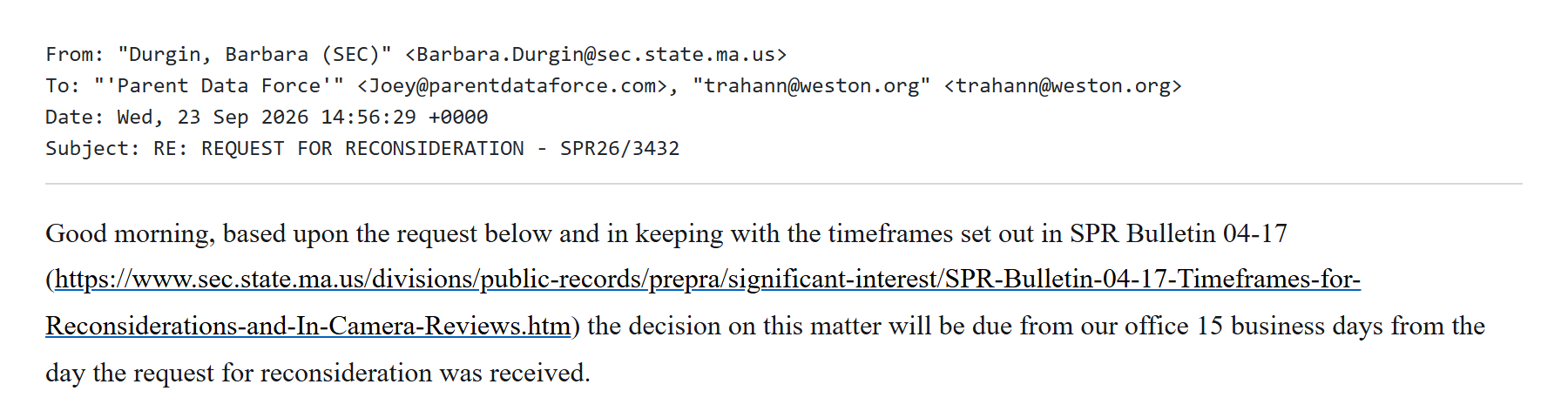
- Reconsideration was requested September 18 and acknowledged September 23, with a decision due 15 business days from receipt. No responsive record has been produced and no reconsideration determination has issued.
What the records do not establish
- It is not established that the fee was unreasonable. No one has so held; the estimate has never been ordered reduced or waived.
- It is not established that the fee was reasonable either. “Not decided” is not “upheld,” and the September 14 determination expressly declined to resolve the fee components.
- It is not established that the district contradicted itself. August 14 says employees had already spent several hours searching; August 28 says no electronic searches were conducted for purposes of the fee estimate. Both can be true. The relationship between them is unexplained, which is a narrower claim than a contradiction.
- It is not established what the DEI Coordinator actually did. No work product has been produced — not a job description, not an organizational chart, not a ninety-day plan, not a single email.
- It is not established that the Supervisor ignored the 2:08 p.m. submission. The twelve-minute gap is established; whether the submission was considered is unknown.
- It is not established that the § 10(e) fee-bar theory will succeed. It is pending and undecided.
- It is not established that the fee would have produced nothing, or everything. Nobody knows what is in the records.
- It is not established anything about the merits of DEI as policy. Nothing in this record speaks to that question.
What can reasonably be assumed pending further records
Neither established nor refuted. These are the readings the current record supports as the most economical explanation of an estimate built without measurement. No source states any of them, and none should be cited as a finding.
- The methodology records probably do not exist, or are thin. A district that had logged hits or built worksheets supporting a 10,000-page floor would have had a straightforward time to produce them on August 28. An estimate built from experience and professional judgment is lawful; it is also an estimate.
- The 10,000-page figure probably includes material the request had already excluded. Automated notifications, all-district mail and scheduling traffic are the ordinary way a three-month workload acquires five figures.
- The 1,000-page copying assumption probably reflects a default rather than a review. No particular record is identified in either response as requiring physical copying.
- The eight-hour conversion step probably anticipates a workflow the request asked Weston not to use, since the estimate describes compiling “to a single file,” saving to another file, and converting.
- The narrowing suggestions probably did not narrow. Weston suggested identifying the employee and time frame in August — both already supplied by the July 31 request.
- The records probably exist. A coordinator’s first three months in a district that created the position would ordinarily leave job descriptions, organizational charts, onboarding plans, calendars and sent email.
Timeline
- July 31, 2026 — the request. Sent at about 10:02 p.m. Eastern to Records Access Officer Neil Trahan, covering Shannon Sheldon’s first three months as Weston’s DEI Coordinator, September 18 through December 18, 2023. Five enumerated record categories, express exclusions for student personally identifiable information and private personnel information, and a request for native electronic production with no single flattened PDF portfolio.
- August 14, 2026 — the response and the fee. Weston objected that terms including “concerning,” “materially contributed to,” and “work-related” were insufficiently specific, summarized the request as essentially all documents that in any way relate to the employee or the position, stated that employees had already spent several hours searching, and issued a fee estimate of $5,416.67 requiring advance payment. No production date was given.
- August 14, 2026 — two more filings. A second request sought the search logs, query logs, hit counts, inventories, worksheets, and calculations underlying the estimate. An appeal to the Supervisor of Records challenged the specificity objection, the grounding of the fee, the conversion of native records, the copying charge, the breadth of the assumed redaction time, the absence of rolling production, and the public-interest fee waiver. It became SPR26/3192.
- August 17, 2026 — acknowledged. The Public Records Division acknowledged the appeal and notified Weston.
- August 28, 2026 — the supplemental response. Weston issued a four-page response that both supplemented the July 31 request and answered the methodology request. It identified the basis of the estimate as internal discussions, advice of counsel, employee knowledge of electronic systems, prior experience, and the district’s understanding of the request — and then stated that “The District did not conduct electronic searches for purposes of its fee estimate.” It reported no written methodology communications except potentially privileged ones, and no other versions of the estimate. The $5,416.67 was not withdrawn.
- August 28, 2:08 p.m. — supplemental submission. A supplemental submission in SPR26/3192 was filed addressing the new August 28 response.
- August 28, 2:20 p.m. — SPR26/3192 closed. The determination closed the appeal because the district had issued a further response, and preserved the right to appeal that response. It was a procedural closure, not a ruling on the merits of the fee.
- August 28, 2:51 p.m. — reconsideration sought. Parent Data Force wrote that the 2:08 submission did not appear to have been considered, and requested reconsideration.
- August 28, 3:03 p.m. — second appeal. A new appeal of the August 28 response was filed, arguing that it did not cure the original defects and in several respects confirmed them.
- August 29, 2026 — the paraphrase supplement. A narrow supplement argued that Weston’s characterization — essentially all documents that in any way relate — was broader than the July 31 request, which named one employee, one position, one three-month period, five categories, exclusions, and production instructions.
- August 31, 2026 — SPR26/3432 opened. The new appeal was acknowledged and assigned docket SPR26/3432.
- September 14, 2026 — the determination. The Supervisor recited the municipal fee rules and both parties’ positions, then found the request very broad in scope, quoted the 2023 *Friedman* decision, encouraged the parties to communicate and potentially narrow the request, noted that any revision would require a revised fee estimate, and closed the appeal. It did not rule that the estimate was lawful.
- September 18, 2026 — reconsideration. Reconsideration of SPR26/3432 in its entirety was requested, raising twenty substantive issues including the later published 2024 Appeals Court decision in *Friedman* and a § 10(e) theory that a non-compliant day-ten response does not preserve fee authority.
- September 23, 2026 — acknowledged. Assistant Director Barbara Durgin acknowledged the reconsideration and stated that under SPR Bulletin 04-17 the decision would be due 15 business days from the day the request was received. No reconsideration determination has been located.
Key records from the fee dispute
Ten unaltered crops of the primary documents: the request, the district’s two responses, both Supervisor determinations, and the acknowledgement of the pending reconsideration. The two response PDFs and the two determination PDFs are crop sources only and are not published as downloads.


What is still blocked
- No responsive record has been produced. Not one category, not one document.
- No production date exists. Neither the August 14 nor the August 28 response supplied one, and the September 14 determination did not require one.
- No hit count exists. Nothing in the record states how many responsive records there are.
- The 10,000-page minimum has no identified request-specific basis — and so, derivatively, neither does the 166.66-hour review figure.
- The 1,000-page copying assumption has no identified basis.
- The two search statements have not been reconciled: whether the earlier searching was manual, which systems were involved, what it found, and whether it informed the estimate.
- No task-by-task basis for the $25 rate has been shown, and no allocation of chargeable versus nonchargeable review time.
- There has been no ruling on § 10(e).
- There has been no reconsideration determination.
- The 2024 Massachusetts Appeals Court decision in Friedman has not been addressed in a determination.
- No discrete, readily identifiable category has been separately produced. A job description, an organizational chart and a first-90-day plan would cost almost nothing to produce and would answer a meaningful part of the accountability question.
Add to this record
If you hold a record from this matter — a Weston response, a determination, a filing, or a copy of something the district has since produced — send it to us. Corrections to anything published here are welcome, and we will report a reconsideration decision as soon as it issues.