
Three months of work by a publicly funded DEI Coordinator. One records request. A bill for $5,416.67 that nobody has yet ruled lawful or unlawful — and a transparency question that is still, nine months later, unanswered.
A position was created, money was spent filling it, and then the public asked a simple question: what was it for? The answer, in the form of records, was priced at five thousand four hundred sixteen dollars and sixty-seven cents. That is the whole shape of this story. It is not a story about whether a district should have a Diversity, Equity, and Inclusion Coordinator. It is a story about what it costs to look.
What this project evaluates. This is a project about how public tax dollars are used for administrative roles, examined through one publicly funded position as a case study. The position in view — a Diversity, Equity, and Inclusion Coordinator — is exclusively dedicated to DEI. That is precisely what makes it a workable test case: every public dollar behind it was spent on work that only that role would do, so the record of that work is a clean measure of what the position actually produced. The project is not an evaluation of DEI as a policy question, and it takes no position for or against DEI, its methods, or its conclusions. It asks four narrower questions: what the position was assigned to do, what it was paid to produce, what it actually produced, and what it costs the public to find out.
The position
In the fall of 2023, the Weston Public Schools hired a Diversity, Equity, and Inclusion Coordinator. The position was publicly funded, in the ordinary way that any school district position is publicly funded: through the budget that residents vote on and pay for.
That is the beginning of the accountability question, and it is a question that does not require anyone to hold a view about the underlying policy debate. A district can hold views. A district can also produce records about what a position was assigned to do, what it actually did, and what came out the other end. Those records are public. The public asked for them.
The specific employee here is Shannon Sheldon, and the specific window is her first three months on the job, from September 18 through December 18, 2023. That window was chosen for a reason worth stating plainly: the beginning of a role is when the written expectations — the job description, the goals, the onboarding plan, the first-90-day plan — are at their most distinct from whatever the person actually ends up doing. Three months is short enough to be answerable and long enough to contain real work.
The rest of this article follows two threads that are often told as one and should not be. The first is what the public asked to inspect. The second is what happened when the public asked. The second thread has so far swallowed the first, which is itself the finding.
The July 31 request
At approximately 10:02 p.m. Eastern on July 31, 2026, Parent Data Force sent a public-records request to Weston’s Records Access Officer, Neil Trahan. The subject line named the employee, the position, and the dates: Public Records Request – Shannon Sheldon DEI Coordinator Records (September 18–December 18, 2023).
The request was not a fishing expedition. It named one person, one position, one three-month period. It stated its purpose in a single sentence, and that sentence is the reason this project exists:
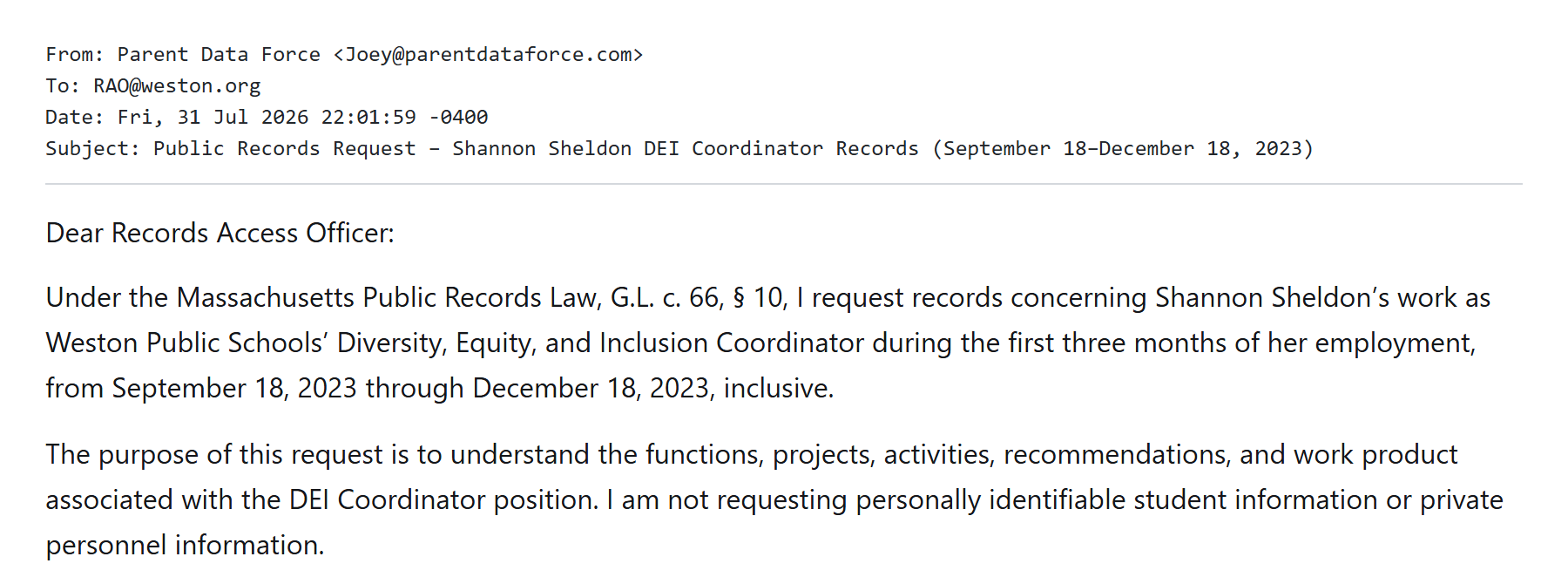
The request also asked Weston to say so if the records would be provided in a form other than the one requested, before any chargeable work began, and offered to take the records in stages. That last offer matters later. The appeal that followed would argue that plainly identifiable material — a job description, an organizational chart, a ninety-day plan — could and should have been produced on its own, without paying five thousand dollars to find out whether it existed.
The five categories
The request was organized into five numbered categories, each with worked examples rather than adjectives.
- Role, assignments, and expected work. The job description, the job posting, a statement of duties, the organizational chart, the reporting structure, the approved scope, the onboarding plan, the first-90-day plan, the work plan, goals, priorities, assignments, expected deliverables, directives, performance measures, any project, committee, or initiative assignments, and non-exempt records documenting status, progress, completion, outcomes, or results.
- Work files and work product. Memoranda, reports, recommendations, summaries, guidance, research, analyses, presentations, training materials, spreadsheets, trackers, databases, surveys, project plans, calendars, task lists, meeting materials, policy or procedure drafts, equity reviews and assessments, newsletters and outreach material, vendor and consultant records, and records concerning DEI-related programming, curriculum, hiring and workforce diversity, professional development, school climate, belonging, multicultural programming, equity, access, inclusion, anti-bias work, bullying prevention, and social-emotional learning.
- Email and electronic communications. Substantive work-related messages sent or received during the three-month period, concerning her duties, assignments, recommendations, projects, meetings, initiatives, work product, and official activities.
- Meetings and calendar records. Work-related calendar entries, invitations, agendas, attached materials, records identifying committees and working groups attended in an official capacity, notes, minutes, summaries, follow-up, action items, and deliverables.
- File inventories and audit exports. Any existing Google Workspace, Drive, shared-drive, or administrative inventory or audit export identifying files created, owned, uploaded, or materially edited by Sheldon during the period.
The fifth category deserves a note, because it is the one that should have been cheapest to satisfy and the one that would have answered the volume question outright. It asked only for records that already exist. It did not ask Weston to build anything, analyze anything, or count anything from scratch. If Google Workspace can produce a per-user file inventory, the question of whether there are ten thousand responsive pages or two hundred stops being a matter of opinion.
What was deliberately excluded
The request narrowed itself with unusual care, and the narrowing was not incidental. It was the point.
- Student personally identifiable information was expressly disclaimed.
- Private personnel information was disclaimed: social security numbers, home addresses, personal phone numbers and email, banking information, medical information, payroll, benefits, and private leave information.
- Routine automated notifications, spam, purely personal messages, payroll and benefit communications, and scheduling-only messages with no substantive discussion were all carved out of the email category.
- Private appointments, leave information, and student-specific meetings were expressly subject to exclusion or redaction.
A request that begins by promising not to hand over anything about a student, a home address, or a medical appointment is not a request designed to embarrass anyone. It is a request designed to be granted.
The production instructions were equally specific. Email was to come as `.mbox` with full headers, dates, sender and recipient fields, original attachments, and complete threads, deduplicated only for exact duplicates. Spreadsheets were to come as `.xlsx`, `.csv`, or the original format. Word and presentation files were to come as `.docx` and `.pptx` or the original editable form. Names, paths, formulas, worksheets, comments, notes, metadata, and available version history were to be preserved. Original attachments were to be included. And the request asked explicitly for no single flattened PDF portfolio.
That last instruction is worth holding onto. It was made in July. In August, the district’s fee estimate would bill eight hours of employee time partly for saving records to one file, converting them, and reproducing them.
Why the public asked
The request also asked for a fee waiver, and gave its reasons: the records concern the work and activities of a publicly funded district position, disclosure would contribute to public understanding of district operations, and the request was not commercial.
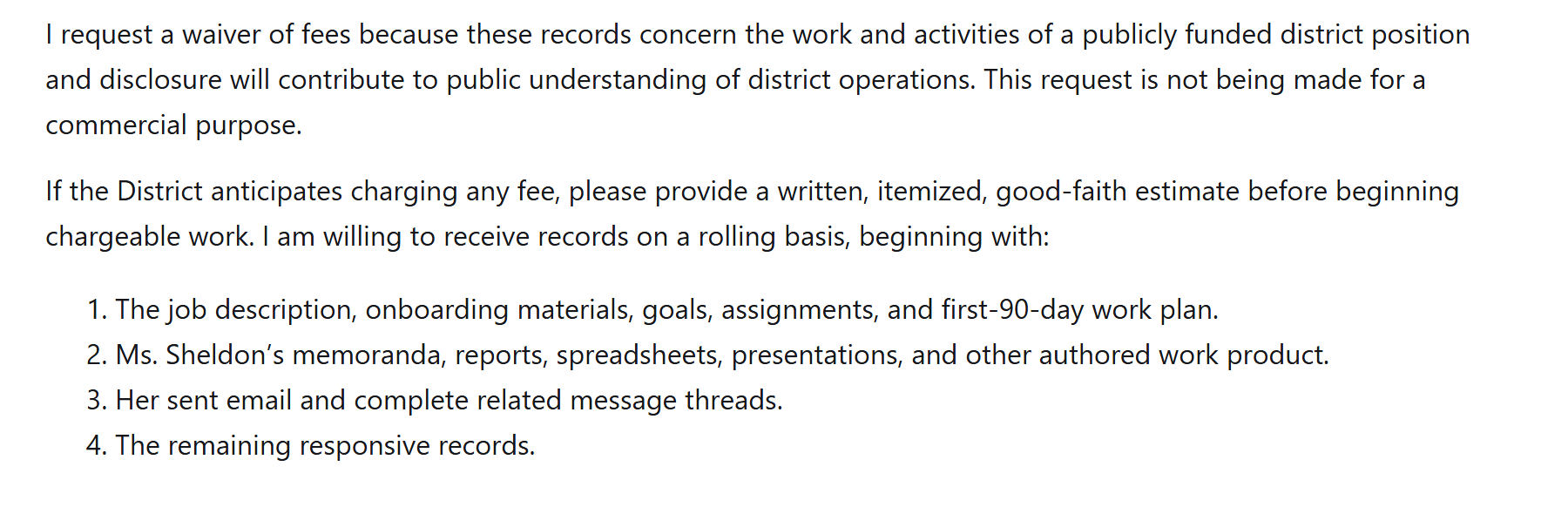
There is a circularity trap here that is worth naming before the district’s response arrives. A records fee is justified by the cost of finding records. If the only way to learn the cost of finding records is to pay for the finding, then the fee is self-justifying: the district estimates that the work is large, charges for the work, and the estimate is confirmed by the fact that the work was charged for. A request that asks for the methodology behind the number is a request to break that circle, and the July 31 request asked for it in a second, separate message sent on the same day the district first priced the work.
Weston’s first answer
Neil Trahan responded on August 14, 2026 — the tenth business day. The response argued that the request was insufficiently specific, objecting to terms including concerning, materially contributed to, materially edited, in connection with, curriculum-related, work-related, related documentation, connected with her work, related initiatives, and substantive. It summarized the request as essentially seeking all documents that in any way relate to Sheldon or the DEI Coordinator position, including metadata.
It also said that Weston had attempted to formulate searches that would identify as many records as possible, and it anticipated a substantial segregation and redaction burden across student records, personnel and privacy information, personal contact information, personal notes, attorney-client communications, union communications, 51A reports, intellectual property, executive-session material, attorney work product, investigatory material, tests and assessments, and security information.
And then it said this:
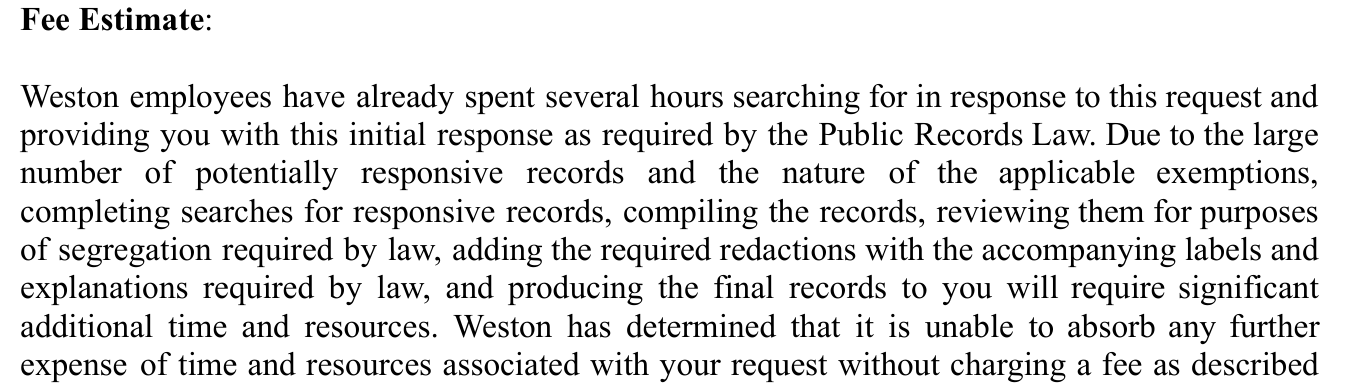
Under the heading Fee Estimate, the district told the requester that its employees had “already spent several hours searching.” Hold that sentence. It will matter a great deal six weeks later.
The fee, item by item
The estimate was $5,416.67. It was built as follows.
- Search and compilation: 40 hours. At least one week of dedicated employee time to search and compile responsive records “to a single file.”
- Volume assumption: at least 10,000 pages. The district said it anticipated tens of thousands of potentially responsive pages and used 10,000 as a minimum.
- Segregation and redaction: 166.66 hours. One minute per page across that 10,000-page minimum.
- Conversion and reproduction: 8 hours. Another full day to save the records to another file and convert and reproduce them in a legally compliant format.
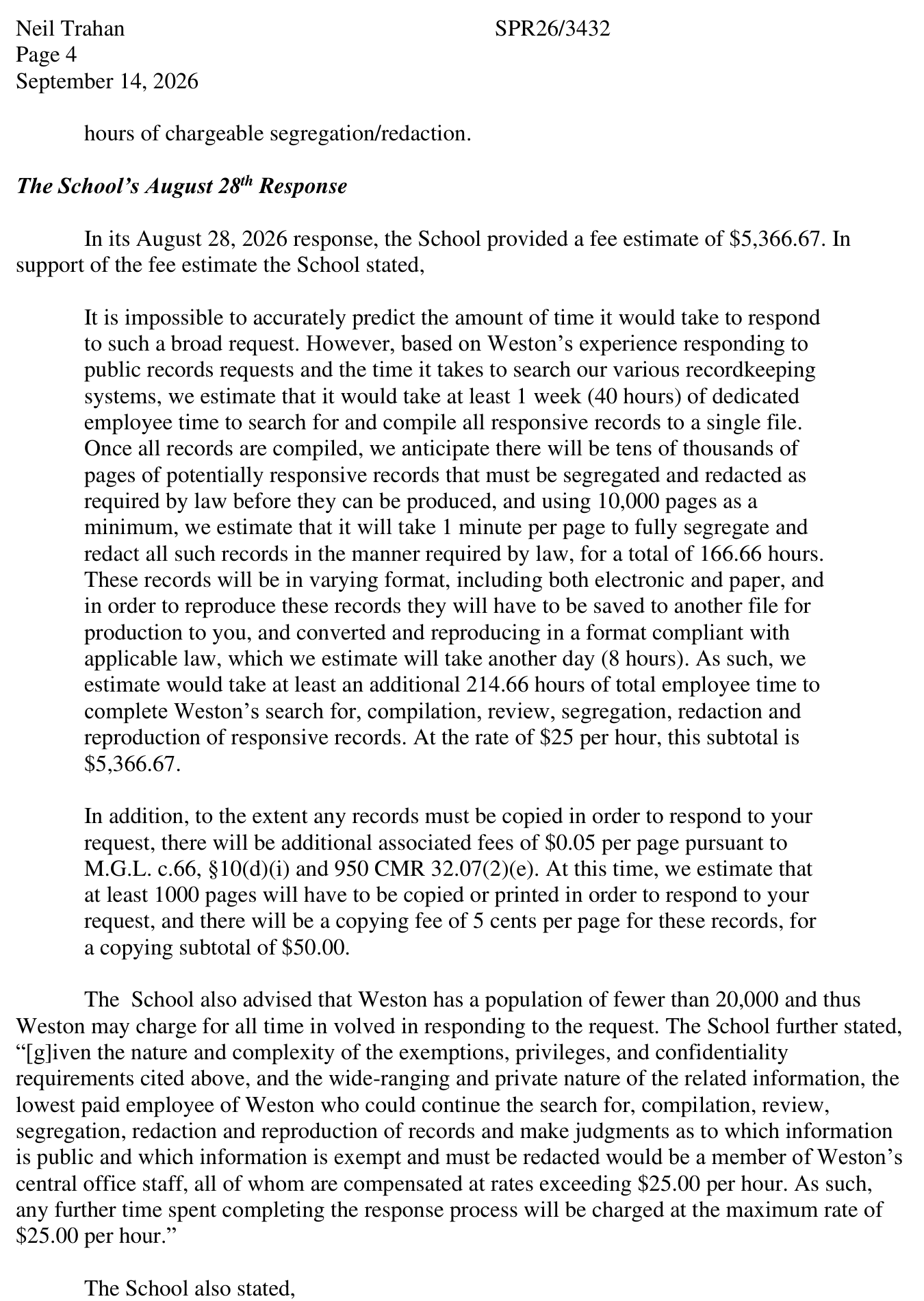
- Total labor: 214.66 hours at $25 per hour. Subtotal stated as $5,366.67.
- Paper and copying: at least 1,000 pages at $0.05 per page, or $50.
- Total estimate: $5,416.67.
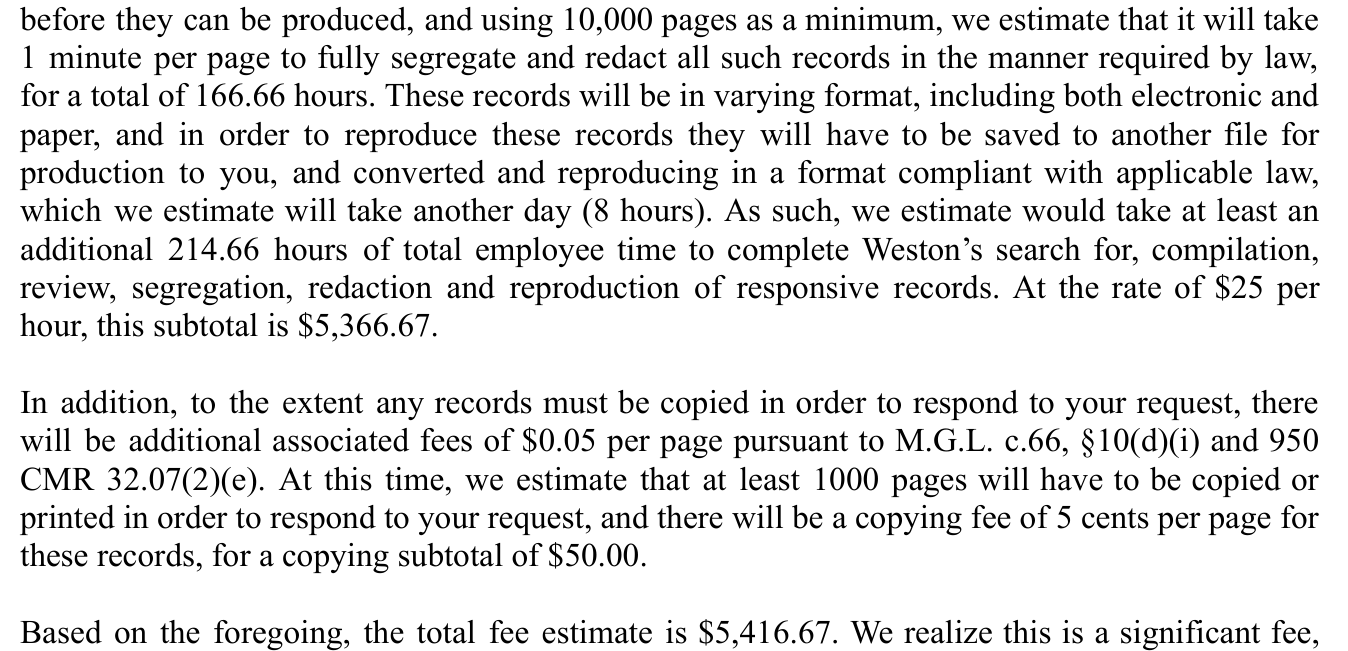
Four features of this table deserve attention, and none of them is the total.
The largest component is a derivative. Segregation and redaction at one minute per page across 10,000 pages is 166.66 hours. Strip the 10,000 and you have no number at all. The 10,000 is not a measurement. It is a floor chosen to make the multiplication possible.
The volume assumption and the request are in tension. The request named one employee, one position, one three-month period. A person produces work; she does not produce ten thousand pages of it in a quarter, unless the ten thousand pages are something else — automated notifications, board packets, all-district mail, the accumulated attachments of every message sent to a distribution list. The request had already excluded routine automated notifications and scheduling-only messages. What remains of the 10,000 is unstated.
The conversion step contradicts the request. The request asked for native electronic files, original formats, preserved metadata, and explicitly no single flattened PDF portfolio. The estimate charges for compiling records “to a single file,” then saving them to another file, then converting and reproducing them. The estimate describes a paper-adjacent workflow being priced to a request that asked not to have one.
No date was given. The response required advance payment before the district would proceed with the process it described, warned that additional fees would be charged if the work ran longer or more records had to be printed, and stated no production date at all.
The same day: a request for the basis
Minutes after Weston’s response landed, and around the same time the first appeal was filed, a second public-records request went out. This one did not ask for the DEI Coordinator’s records. It asked for the evidence underneath the price tag.
It sought search, query, audit, export, and eDiscovery logs; the actual terms, filters, date ranges, custodians, accounts, drives, folders, repositories, systems, and data sources used; hit counts and result counts; export and collection manifests; inventories; deduplication reports; processing and indexing reports; the records supporting the 10,000-page figure; the records supporting the 40-hour search estimate; the records supporting the 166.66-hour review estimate; any sampling or timing studies; the records supporting the eight-hour conversion estimate; the records supporting the 1,000-page copying estimate; any worksheet, calculation, note, memorandum, or email used to calculate $5,416.67; communications about methodology; the employee and vendor roles and rates used; records reflecting searches, sampling, or test exports already performed; and any draft fee estimates containing different figures.
This is the request that should decide the case, and it is the one that has produced the least. If the district can produce a hit count, the volume question stops being an estimate and becomes a fact. If it cannot, then the estimate is judgment — which is entirely lawful in itself, but is judgment that the public is entitled to see the shape of.
First appeal: SPR26/3192
The same day, Parent Data Force appealed the August 14 response to the Supervisor of Records. The appeal was careful to acknowledge that August 14 was the tenth business day and did not allege simple lateness. The argument was about compliance and grounding, not speed.
The issues raised were whether the request reasonably described the records; whether the response complied with the requirements of G.L. c. 66, § 10(b); whether the fee was sufficiently itemized and grounded; whether native and electronic records were being converted contrary to the requested format; whether the paper-copy costs were justified; whether chargeable redaction time was being assumed too broadly; whether plainly identifiable records should have been produced separately on a rolling basis; and whether the requested public-interest fee waiver had been meaningfully considered.
The appeal became SPR26/3192. It was acknowledged on August 17.

The appeal was never decided on the merits. On August 28, after the district filed a new response, the Supervisor closed it — see section twelve — and said the substantive nature of the new response could be appealed. The appeal did not rule that the fee was proper, and it did not rule that it was improper. It simply stopped, because the document it was reviewing had been replaced.
The August 28 supplemental response
On August 28, Weston sent a four-page supplemental response doing two jobs at once: supplementing the July 31 request in SPR26/3192, and answering the August 14 request for the methodology behind the fee. It again objected that the methodology request used broad phrases, including reflecting, similar, in connection with, substantiate, and support.
It then identified the basis of the August 14 estimate: internal discussions, advice of counsel, employee knowledge of electronic systems and technical expertise, prior experience searching, compiling, segregating, redacting, and producing public records, and the district’s understanding of the original request.
Every one of those is a real input. Together they explain where a number came from without showing how it was calculated. No hit count. No page count. No sample. No timing study. No search log. The district added that any search and compilation time was subject to payment of the fee; that there were no written communications related to the methodology except potentially privileged communications with counsel; that there were no versions of the August 14 estimate containing different figures; and that beyond what it had described, it was not aware of other responsive methodology records in its possession.
And it did not withdraw the $5,416.67.
“The District did not conduct electronic searches”
Then came the sentence that defines this dispute:
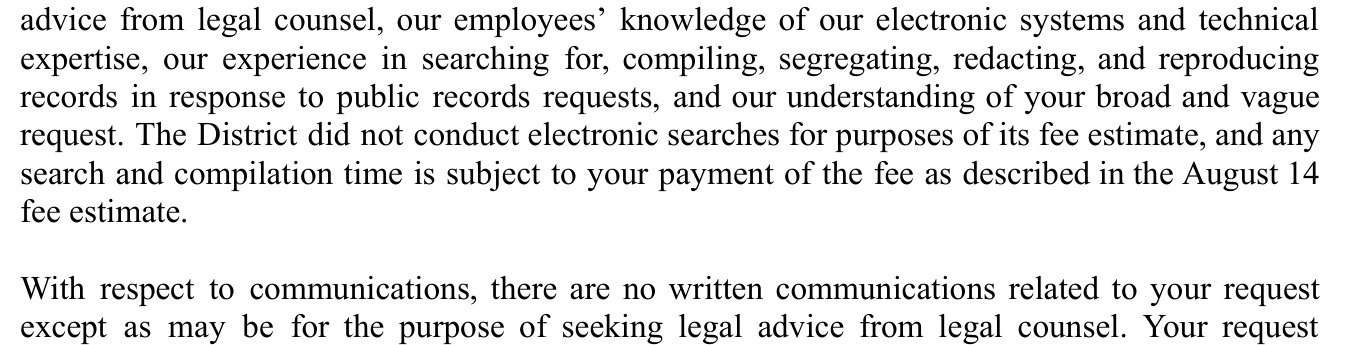
The precise words matter, and so does the precision with which they must not be paraphrased. Weston did not say it did no search. It said it did not conduct electronic searches for purposes of its fee estimate. That qualifier is doing real work. It leaves open — indeed it invites — the possibility of searches conducted for some other purpose.
Compare it to August 14, where the district said employees had “already spent several hours searching.”
These two statements are not necessarily inconsistent. A manual review of a filing cabinet and an electronic search across a Google Workspace account are different acts, and a district could plausibly have done the first and not the second. The problem is not that the statements clash. The problem is that nobody has explained the relationship between them, and nobody is required to have.
- Was the earlier searching manual, or electronic?
- Which systems were searched, by whom, and when?
- What did it turn up?
- Did it inform the 10,000-page floor or the 40-hour figure, or neither?
An estimate for an electronic records request, built on a 10,000-page floor and 166.66 hours of per-page review time, is an estimate about electronic records. If no electronic search was conducted to produce it, then the number describes a district’s expectation rather than a measurement of the corpus — and the public is being asked to pay on the expectation.
The appeal that followed did not claim a contradiction. It claimed an unexplained relationship. That distinction is the difference between a grievance and a grievance that is right.
Twelve minutes
The same day carries one more piece of chronology, and it is the kind of detail that gets lost in a summary and should not.
At 2:08 p.m. Eastern, Parent Data Force filed a supplemental submission in SPR26/3192 addressing Weston’s new August 28 response. At 2:20 p.m., the SPR26/3192 determination arrived. At 2:51 p.m., Parent Data Force wrote back stating that the 2:08 submission did not appear to have been considered, and sought reconsideration. At 3:03 p.m., it filed a new appeal of the August 28 response. Public Records Division staff asked clarifying questions about whether a further appeal was intended and requested the response being appealed; Parent Data Force supplied it and clarified that both a reconsideration request and a new appeal had been pursued. The new appeal was acknowledged as SPR26/3432 on August 31.
What the record establishes is a twelve-minute gap. What the record does not establish is whether the Supervisor saw the 2:08 submission before issuing the determination at 2:20. A determination drafted before 2:08 and sent at 2:20 would look identical from the outside to one that considered the submission and rejected it in twelve minutes. No inference about either is available, and none is offered here.
What can be said is narrower and still worth saying: the 2:08 submission went unanswered on its own terms, and the 2:51 message that said so is the reason there is a second appeal at all.
Second appeal: SPR26/3432
The new appeal argued that the August 28 response did not cure the defects in the August 14 estimate and, in several respects, confirmed them. Its seven points were: that the district had now expressly confirmed it conducted no electronic search for purposes of the estimate, and still supplied no hit count, sampling, test export, historical comparator, page-count methodology, repository-specific estimate, or concrete factual basis for the exact figures; that the relationship between “several hours searching” and the no-electronic-search statement remained unexplained; that the 166.66-hour review figure was mechanically derived from an unverified 10,000-page minimum; that the request had specifically sought native electronic production and specifically asked Weston not to consolidate everything into a single PDF portfolio, which the estimate contemplated doing; that the 1,000-page copying assumption remained unaccounted for, with no identification of which records needed to be physically copied or why; that neither response supplied a production date or separately addressed easy-to-identify material such as job descriptions, scope, organizational documents, onboarding material, goals, assignments, and authored work product; and that the August 28 methodology response explained in general terms what informed the district’s judgment without showing how the numbers were calculated.
It became SPR26/3432.
The request as written versus as Weston described it
On August 29, the day after the new appeal, Parent Data Force filed a narrow supplement that sharpened a point that turns out to matter more than it first appeared.
Weston’s August 14 letter had characterized the July 31 request as essentially seeking all documents that in any way relate to Sheldon or the DEI Coordinator position, including metadata. The actual request contained one named employee, one fixed three-month period, five enumerated record categories with worked examples, substantive-work limitations, express exclusions for student and private personnel information, and explicit production instructions.
If the fee estimate was calculated against Weston’s broader paraphrase rather than the request as written, then the estimate may not measure the burden of the request that was actually made. The supplemental filing also noted an oddity: Weston suggested narrowing by identifying the employee, the email account, and the time frame, when the July 31 request had already named the employee and fixed September 18 through December 18, 2023.
A narrowing suggestion that asks for what you were already given is a narrowing suggestion in name only. It is worth watching for in any fee dispute, and it is the sort of detail that separates a request for clarification from a request for a different, smaller request.
The September 14 determination
On September 14, the Supervisor of Records issued a six-page determination in SPR26/3432. It is a careful document, and it is worth reading closely rather than paraphrasing loosely.
It recites the municipal fee rules, including that fees must be reasonable, that the hourly rate is capped at $25 absent an approved higher rate, that municipalities of 20,000 people or fewer may charge for all time involved in responding to a request, and that a municipality may not charge for segregation or redaction not required by law. It then summarizes several of the requester’s central objections — that no electronic search was conducted for the estimate, that the earlier searching statement remains ambiguous, and that the 10,000-page and 166.66-hour assumptions are unsupported — and it summarizes Weston’s methodology in turn.
It then changes direction. The determination turns to the breadth of the request, and cites the earlier Superior Court Friedman decision’s language about the right to seek public records in a reasonable manner and the duty of agencies not to be inundated with “drain-the-ocean” records requests.
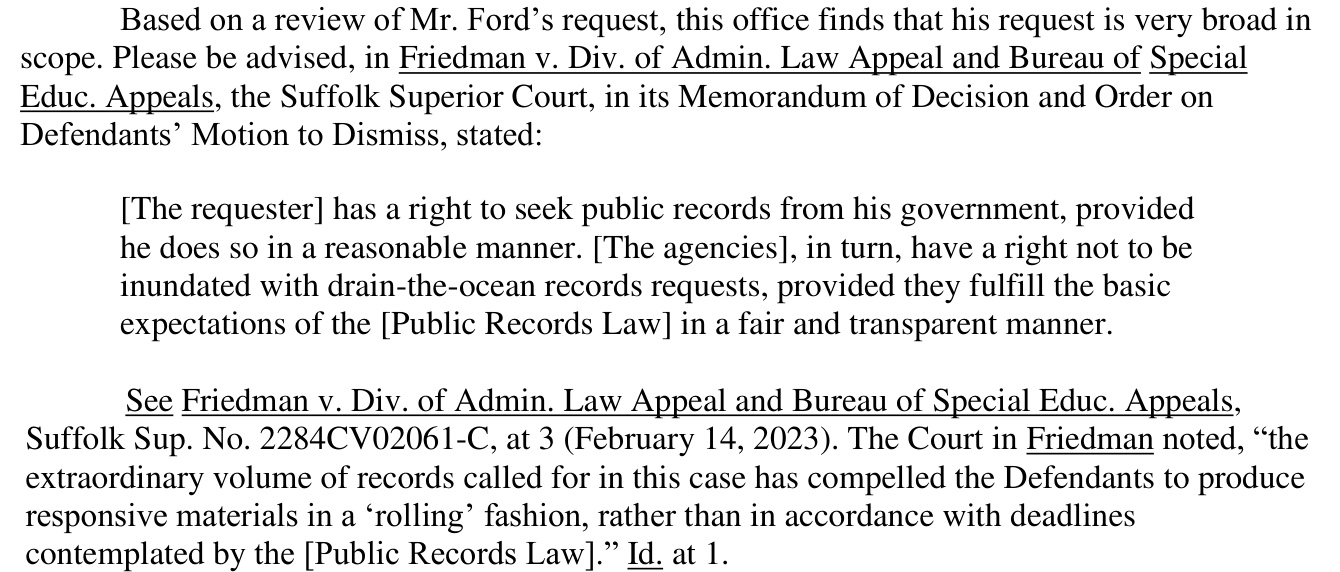
It encourages the parties to communicate about definitions, time frames, substantive scope, search terms, production timing, withholding methodology, and fee methodology. It observes that the requester may wish to narrow the request, citing the statutory provision that a municipality shall suggest reasonable modification of the scope of a request or offer to assist the requester in doing so, and notes that any revision would result in the need to issue a revised fee estimate. It then closed the appeal.
What the determination did not decide
This is the section that matters most, and it is the one most likely to be misreported.
The September 14 determination did not state that the $5,416.67 estimate was lawful. It did not state that the 10,000-page minimum had been proven. It did not state that 166.66 hours of review were properly chargeable, that 40 search hours were justified, that the eight-hour conversion workflow was necessary, or that 1,000 paper copies were needed. It did not find that $25 per hour was the proper rate for every task in the estimate, that the August 14 response satisfied every element of § 10(b), that Weston had supplied a compliant production timetable, or that Weston had preserved its fee authority under § 10(e).
It recited the objections, recited the district’s answers, found the request very broad, encouraged narrowing, and closed the appeal.

The practical consequence is precise. Neither determination has validated the fee. The first appeal, SPR26/3192, was closed procedurally because the district produced a new response; that is not a merits ruling and does not approve anything. The second appeal, SPR26/3432, was closed after the Supervisor characterized the request as very broad and encouraged the parties to talk. A closure that invites further discussion is not a validation of the number that started the fight.
And the fee stands exactly where it stood on August 14: $5,416.67, unwithdrawn, unadjudicated.
Reconsideration: the Friedman question
On September 18, Parent Data Force requested reconsideration of SPR26/3432 in its entirety. The filing ran to twenty substantive sections. The first theory is about authority.
The determination relied on a February 2023 Superior Court Friedman order. The reconsideration argues that the determination did not address the later published 2024 Massachusetts Appeals Court decision in the same matter, and that the appellate decision vacated the dismissal of two public-records claims, including one involving approximately 11,000 potentially responsive emails. On that reading, the argument goes, burden alone does not make a request unreasonable as a matter of law where records can be identified with reasonable effort.
This should be described exactly as what it is: an argument made in a reconsideration filing about how the case law should be read. Parent Data Force is not the Supervisor of Records, this article is not a court, and no independent reading of Friedman is offered or implied here. The question is pending, and the Supervisor of Records will resolve it or decline to.
Reconsideration: the §10(e) question
The second theory is the most consequential, and it is also the one most likely to be misstated as settled.
The reconsideration acknowledges that Weston sent its August 14 letter on the tenth business day. It does not claim lateness. The argument is structural. Section 10(e) permits a municipality to charge a reasonable fee only where the records access officer responded within ten business days under subsection (b). The theory is that a day-ten response that does not itself satisfy § 10(b) cannot preserve fee authority, no matter how quickly it arrived.
The filing identifies the alleged defects: that the letter did not identify the actual records or categories to be produced; did not identify the actual withheld records or categories with specific reasons; did not provide a reasonable production timeframe; did not provide meaningful narrowing assistance; and did not provide an adequately grounded and itemized estimate.
The requested ruling is that if the day-ten response did not comply with subsection (b), Weston lost the right to charge a fee at all.
This remains an argument pending reconsideration. It is not an established ruling, and it should not be described as one. The reconsideration also treats the discretionary public-interest fee waiver as an alternative argument rather than the primary basis, and the practical result is stark: after SPR26/3432, no responsive record has been produced, no production date exists, no request-specific electronic search was used to develop the estimate, no hit count exists, no objective basis for the 10,000 pages has been identified, no basis for the 1,000 paper copies has been identified, no allocation of chargeable versus nonchargeable review has been established, no task-by-task basis for the $25 rate has been shown, the two search statements have not been reconciled, no discrete record category has been separately produced, and no ruling has issued on the § 10(e) theory.
Current status
On September 23, 2026, Assistant Director Barbara Durgin of the Public Records Division acknowledged the reconsideration request and stated that, under SPR Bulletin 04-17, the decision would be due 15 business days from the date the request was received.
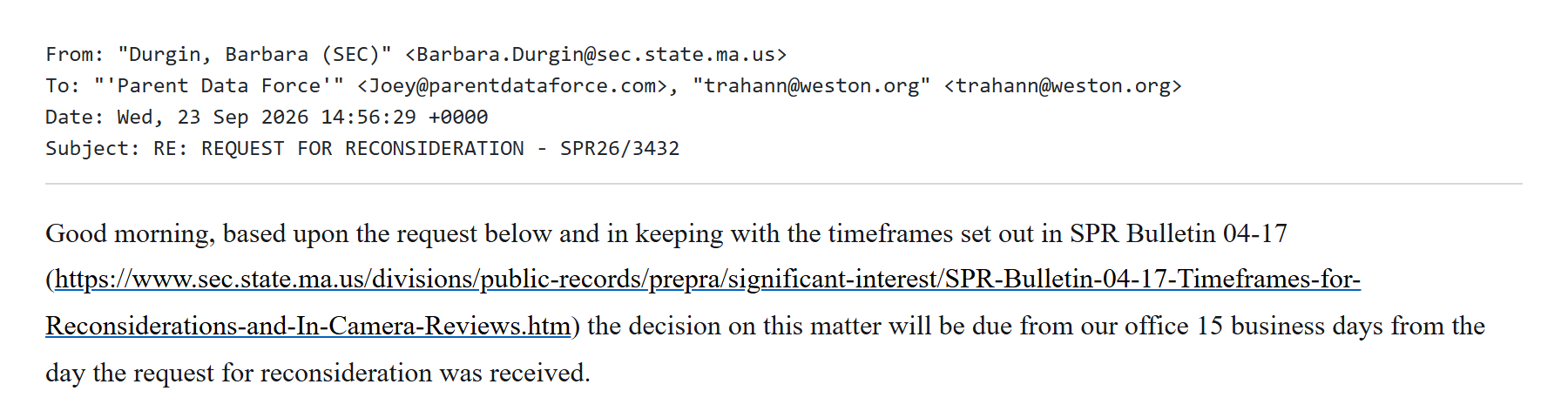
As of the date of this article, no reconsideration determination has been located in the connected mail record. The reconsideration is pending. Neither the $5,416.67 estimate nor the § 10(e) theory has been decided, and no responsive record has been produced.
The project page for this matter is at Weston Public Schools DEI Records Project, and it tracks the same record.
The fee math: a rounding detail, not an overcharge
There is one number in this story that looks like a discrepancy and is not, and it is worth disposing of plainly so that it is not mistaken for the scandal.
Weston displayed 214.66 total hours — 40 hours of search, 166.66 hours of review, 8 hours of conversion — and stated a labor subtotal of $5,366.67 at $25 per hour. Multiplying the displayed figure gives 214.66 × $25 = $5,366.50, which is seventeen cents short of what the district stated.
The explanation is in the derivation of the 166.66. Weston priced review at one minute per page across a 10,000-page minimum. Ten thousand minutes divided by sixty is 166.6666… hours, not 166.66. Adding the untruncated figure:
- 10,000 minutes ÷ 60 = 166.6666… hours
- 40 + 166.6666… + 8 = 214.6666… hours
- 214.6666… × $25 = $5,366.6666…, which rounds to $5,366.67
- $5,366.67 + $50.00 in copying = $5,416.67
The stated total is reproduced exactly. What the district displayed was the hours figure rounded for readability while computing the money from the unrounded figure. That is a presentation choice, and an unfortunate one — a reader checking the arithmetic will always find the seventeen cents and will reasonably wonder what else does not add up. But it is not evidence of an overcharge, and it is not a billing error.
It is worth saying what this is not. It is not evidence that the $5,416.67 is right. Arithmetic that is internally consistent tells you the district added up its own assumptions correctly. It says nothing about whether the assumptions were measured, and they were not.
What the record establishes
The following are established by the documents reproduced in this article and by the district’s and the Supervisor’s own written statements.
- Weston Public Schools created and funded a Diversity, Equity, and Inclusion position held by Shannon Sheldon, whose first three months ran from September 18 through December 18, 2023.
- On July 31, 2026, Parent Data Force submitted a public-records request for records of that role, period, and work product, limited to five enumerated categories, expressly excluding student personally identifiable information and private personnel information, and requesting native electronic production.
- On August 14, 2026, the district responded, objected to specificity, stated its employees had “already spent several hours searching,” and issued a fee estimate of $5,416.67 requiring advance payment, with no production date.
- That estimate was built from 40 search hours, a 10,000-page minimum, 166.66 review hours, 8 conversion hours, and $25 per hour, plus $50 for at least 1,000 copied pages.
- On August 14, 2026, a second request sought the search logs, hit counts, and calculations behind those figures, and an appeal was filed.
- On August 28, 2026, the district stated: “The District did not conduct electronic searches for purposes of its fee estimate.” It also stated there were no written communications about the methodology except potentially privileged communications, and no versions of the estimate with different figures. It did not withdraw the estimate.
- SPR26/3192 was closed procedurally on August 28 because of the district’s new response, with the substantive nature of that response preserved for appeal.
- A supplemental submission at 2:08 p.m. on August 28 preceded the SPR26/3192 determination at 2:20 p.m.
- The new appeal, SPR26/3432, was acknowledged August 31.
- The September 14, 2026 determination recited the fee rules and both parties’ positions, found the request “very broad in scope,” quoted the 2023 Friedman decision, encouraged communication and narrowing, noted that a revised request would require a revised fee estimate, and closed the appeal.
- That determination did not rule that the $5,416.67 estimate was lawful, did not establish the 10,000-page or 166.66-hour figures, did not approve the $50 copying charge or the $25 rate, and did not decide the § 10(e) theory.
- Reconsideration was requested September 18 and acknowledged September 23 with a decision due 15 business days from receipt.
- No responsive record has been produced, and no reconsideration determination has issued.
What the record does not establish
These are the things a reader might reasonably assume from the story so far, and cannot, because the record does not say them.
- It does not establish that the fee was unreasonable. No one has so held. Weston has never been ordered to reduce, waive, or justify the $5,416.67, and no decision has upheld it either.
- It does not establish that the fee was reasonable. Equally, nothing has upheld it. “Not decided” is not “upheld,” and the September 14 determination expressly declined to resolve the fee components.
- It does not establish that the district contradicted itself. August 14 says employees had already spent several hours searching. August 28 says the district did not conduct electronic searches for purposes of its fee estimate. These can both be true. The relationship between them is unexplained, which is a different and narrower claim.
- It does not establish that the $25,000-plus in labor would have produced nothing, or everything. Nobody knows what is in the records. That is the entire problem.
- It does not establish what the DEI Coordinator actually did. No work product has been produced. Not a job description, not an organizational chart, not a ninety-day plan, not a single email.
- It does not establish that the Supervisor ignored the 2:08 p.m. submission. The submission preceded the determination by about twelve minutes. Whether it was considered is unknown.
- It does not establish that the § 10(e) fee-bar theory will succeed. It is pending, it has not been ruled on, and a losing theory is still a theory.
- It does not establish anything about the merits of DEI as policy. Nothing in this record speaks to that question, and nothing in this article should be read as speaking to it.
What can reasonably be assumed
The tier below is inference, not finding. Each item is a reasonable reading of the record rather than a statement the record makes. Each is labelled as an assumption because it is one.
- The methodology records probably do not exist, or are thin. A district that had run searches, logged hits, or built worksheets supporting a 10,000-page floor would have had a straightforward time to produce them on August 28. The statement that there are no written communications except potentially privileged ones, and no other responsive methodology records, is consistent with an estimate built from experience and professional judgment rather than from measurement. That is lawful. It is also an estimate.
- The 10,000-page figure probably includes material the request had already excluded. Automated notifications, all-district mail, and scheduling traffic are the ordinary way a three-month workload acquires five figures. This is an inference from the arithmetic, not a finding, and Weston has not said what the 10,000 pages are.
- The 1,000-page copying assumption probably reflects a default rather than a review. No particular record is identified in either response as requiring physical copying. The district separately noted that the records would be in varying formats, including electronic and paper. Which is which, and why 1,000 pages of it, is unanswered.
- The eight-hour conversion step probably anticipates a workflow the request asked Weston not to use. The request asked for native formats and no single flattened PDF portfolio; the estimate describes compiling “to a single file,” saving to another file, and converting. Whether Weston would actually have produced a flattened portfolio is not established either way.
- The narrowing suggestions probably did not narrow. The Supervisor encouraged narrowing on September 14, and Weston had already suggested identifying the employee and time frame in August — both of which the July 31 request had already supplied.
- The records probably exist. A coordinator’s first three months in a district that created the position would ordinarily leave job descriptions, organizational charts, onboarding plans, calendars, and sent email. This is an inference from how school administration works, not a representation about what Weston holds.
None of the above is a finding, and none should be cited as one.
Open questions
What remains unresolved, stated plainly so that it can be tracked:
- No responsive record has been produced. Not one category, not one document.
- No production date exists. Neither the August 14 nor the August 28 response supplied one, and the September 14 determination did not require one.
- No hit count exists. Nothing in the record states how many responsive records exist.
- The 10,000-page minimum has no identified request-specific basis. So, derivatively, neither does the 166.66-hour review figure.
- The 1,000-page copying assumption has no identified basis.
- The two search statements have not been reconciled. Whether the earlier searching was manual, which systems were involved, what it found, and whether it informed the estimate are all unanswered.
- No task-by-task basis for the $25 rate has been shown, and no allocation of chargeable versus nonchargeable review time.
- There has been no ruling on § 10(e).
- There has been no reconsideration determination.
- The 2024 Massachusetts Appeals Court decision in Friedman has not been addressed in a determination.
- No discrete, readily identifiable category has been separately produced. A job description, an organizational chart, and a first-90-day plan would cost almost nothing to produce and would answer a meaningful part of the accountability question. None has been.
Sources
This article is built from the primary record. The exhibits above are unaltered crops of the documents themselves, reproduced from the district’s responses, the Supervisor of Records’ determinations, and the parties’ own filings.
- Weston’s response and fee estimate, August 14, 2026.
- Weston’s supplemental and fee-methodology response, August 28, 2026.
- Determination in SPR26/3192, August 28, 2026.
- Determination in SPR26/3432, September 14, 2026.
- Parent Data Force’s request for reconsideration in SPR26/3432, September 18, 2026.
- Public Records Division acknowledgement of the reconsideration, September 23, 2026.
- The original request of July 31, 2026 and the fee-methodology request of August 14, 2026.
This matter is documented in full, with the source exhibits, at the Weston Public Schools DEI Records Project. The procedural history of the reconsideration request was published separately as Public Records Appeal — Weston Public Schools — Request for Reconsideration of SPR26/3432. Other Parent Data Force records projects are listed at the projects index.
If you have documents from this matter — a Weston response, a determination, a filing — or you would like to be notified when the reconsideration is decided, write to joey@parentdataforce.com. Records held by a district are public whether or not anyone asks for them, and the asking is the part that is worth doing.
Leave a Reply
You must be logged in to post a comment.