
Two hundred and forty-seven pages of email came back. Forty-seven of them came back black. A 31-page School Committee letter the District itself identified, acknowledged in writing, and asked to be destroyed does not appear in the response the District filed to satisfy the Supervisor’s order.
This article is about two specific holes in East Bridgewater Public Schools’ 2,243-page records production, and about what happened when a state supervisor told the District to explain them.
Neither hole has been filled. Both were described to the Supervisor of Records. One was closed on a procedural ground. The other was answered on September 14, 2026 — and the answer did not mention it.
Why no images from the production appear here. This article reproduces no page of the 2,243-page production. The material at issue is student work, student communications, and personnel correspondence, and a records-disputes article that illustrates itself with the very records in dispute is not a records-disputes article. Every exhibit below is a crop of a public filing.
Forty-seven pages
East Bridgewater’s July 27, 2026 production was thirteen PDFs — File 1 through File 13 — totaling 2,243 pages. In the July 28, 2026 supplemental appeal filed in the first appeal docket, SPR26/2791, the blackout was described page by page:
File 12, pages 73 through 119, contains 47 consecutive pages that are almost entirely blacked out. Page 73 reveals only part of the header of a student email dated April 1, 2025; the substantive content is concealed. Pages 74 through 119 provide essentially no usable information at all. Page 120 abruptly returns to an unrelated newsletter.
The District’s response, in a June 15 cover letter and again on August 17, was a category list. Four things were redacted under Exemption (a) and FERPA: student names; the names of a student’s parent or other family members; a personal identifier; and other information that, alone or in combination, is linked or linkable to a specific student such that a reasonable person in the community could identify the student with reasonable certainty. The District’s own example for the fourth category was the one that matters here: “pages 73-119 of File 12 contain student assignments.”
So the District named the range and characterized its contents. What it did not do, according to the July 28 filing, was identify what record or records occupied those 47 pages, where one record ended and another began, the exemption applied to each record or portion, the facts supporting each exemption, or whether any reasonably segregable information could be released.
That is a narrower complaint than “the district withheld my records.” It is a complaint about the difference between a category and an explanation — and it is a complaint the law in this area anticipates, because the determination quotes the specificity requirement directly: a custodian “must not only cite an exemption, but must also state why the exemption applies to the withheld or redacted portion.”
What the Supervisor decided about it
The August 28, 2026 determination in SPR26/3207 did not rule on the blackout. It did something more useful and more awkward: it split it.
The Supervisor accepted the identity redactions. Where the School redacted student names and parents’ names under FERPA as it operates through Exemption (a), “I find the School has met its burden to redact such information.” The Supervisor added an observation that reads as an empirical judgment about the production: “it is fairly straightforward to see that redactions ahead of email addresses or within email communications are to preserve a student or student’s parent’s identity.”
Then came the hinge: “However, it is unclear how the remaining redactions constitute personally identifiable information or education records as described in the statutes and regulations. The School must further clarify this matter.”
The 47 pages sit inside that “however.” They are not among the redactions found adequate, and they are not among the redactions found improper. They are among the ones that have to be explained.
The determination also preserved the requester’s right to appeal the substance of the District’s eventual response within ninety days. The clarification order was not the last word; it was a question with a deadline attached.
What the District said about the 47 pages
On September 14, 2026 — the tenth business day after the August 28 order — the District answered. Its letter, captioned to SPR26/3207 and SPR26/3203, addressed pages 73-119 directly:
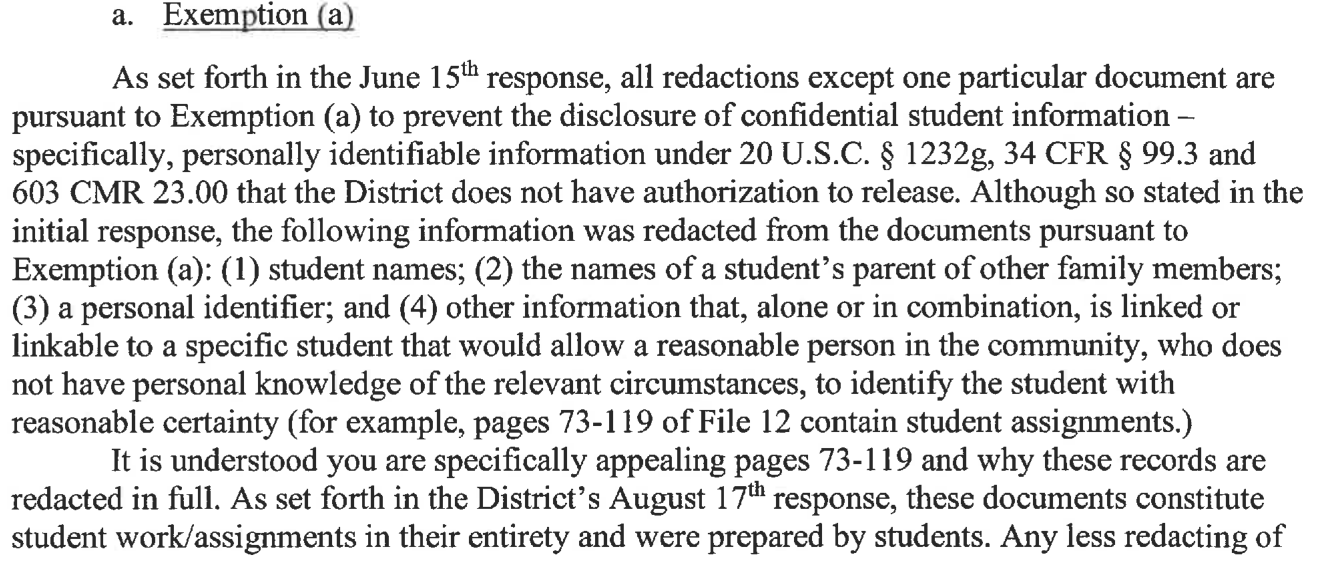
The letter’s argument has two steps. First, “these documents constitute student work/assignments in their entirety and were prepared by students.” Second, “any less redacting of these documents would subject the District to liability for disclosing student record information because it does not have authorization to release these assignments.”
The second step is the one worth noticing, because it is a different argument from the first. The first says the pages are student work. The second says that because the pages are wholly student work, there is no severable non-identifying residue to release. If the first premise is right, the second follows fairly directly: a page of student assignments does not have a non-identifying portion that can be handed over without also handing over the student’s work.
That is a coherent position. It is also, at present, an assertion. The Supervisor has not accepted it. No determination post-dating the September 14 letter had issued as of October 1, 2026.
The attachments nobody produced
The April 27 request asked for complete threads, including messages that did not themselves contain the search term. The July 28 filing identified what came back instead: attachment filenames, without the attachments.
The specific examples given were:
- File 5, page 85 — a Staples quote PDF and an Excel classroom-supply list.
- File 6, page 123 — “Treasurer Report – Feb 25.pdf” and “Agenda 2_12_25.pdf”.
- File 9, page 104 — a delivery photograph.
- File 10, page 177 — a delivery photograph.
A filename is not a record. It is a reference to one. The July 28 filing asked the District to produce each non-exempt attachment in native or reasonably usable electronic form, or to identify it individually as withheld with the specific legal and factual basis.
No filing after September 14 addresses the attachments. The appeal position quoted in the August 28 determination still describes them as “apparently omitted responsive attachments” — the District’s broad statement that it holds no additional records, the requester wrote, “does not reconcile the specific omissions raised in my supplemental appeal, including the known February 2025 employee record and apparently omitted responsive attachments.”
There is a detail here that connects the two omissions. The request asked for complete threads. Attachments are how a thread carries its evidence — a quote attached to an email shows what was purchased and at what price; a treasurer’s report attached to an agenda shows what was voted on. Producing the email and withholding the attachment preserves the thread’s shape while removing its content. Whether that is what happened in Files 5, 6, 9, and 10 is not established. That it is unresolved is.
The record the District identified, acknowledged, and asked to be destroyed
The second hole is the more specific one, and it is the reason this matter did not end with a page count.
On June 2, 2026, the day after the first production, East Bridgewater Public Schools wrote to the requester. The letter, in its own words, said that “certain confidential personnel documents may have been inadvertently disclosed,” and that the District’s understanding was that “you may have received a letter from an employee to the School Committee dated February of 2025.” It stated that the document, and possibly other documents or communications, “should have been withheld and/or redacted.” The District’s IT team was reviewing what had been sent. The District asked the requester to delete and destroy the letter.
The requester did not characterize this. It asked for specifics: which documents, what exemption, a corrected redacted production, an exemption log. What came back instead, on June 15, was a general exemption letter. The February 2025 record’s status was never stated.
The July 27 production did not resolve it either. The July 28 filing noted that the production “does not identify whether that known February 2025 employee letter or any associated packet was included in redacted form; withheld in full; placed somewhere within File 12’s 47-page blackout; or omitted from the corrected production altogether.” The filing noted the significance: the document was responsive to the original keyword search, and it was central to the District’s decision to withdraw and reconstruct its earlier production.
There is a detail in that list of possibilities worth pausing on. One of the four is “placed somewhere within File 12’s 47-page blackout.” A blackout the District says is wholly student work is not an obvious resting place for an employee-to-School-Committee letter. The possibility is included in the filing because the requester could not rule it out from the production’s face, not because the District suggested it.
The August 28 supplemental submission
On the same day the determination issued, a supplemental submission went to the Public Records Division. It identified the record with much greater precision: a 31-page February 11, 2025 letter to the East Bridgewater School Committee, embedded in the preserved copy under the file title “2025-02-11 School Committee letter final PDF.pdf.”
The submission made four points that are worth setting out because each is checkable against the District’s own earlier writing:
- The record was not obtained from an outside source. It was contained in the District’s own original production of responsive email data, including an emails.zip archive containing .pst email data.
- The District acknowledged the exact record in writing on June 2, 2026, quoting itself: “It is our understanding that you may have received a letter from an employee to the School Committee dated February of 2025.”
- The District went further, stating the document “should have been withheld and/or redacted” and asking for its destruction on the belief that it contained confidential information.
- The submission noted the difficulty of reconciling that acknowledgment with the August 17 statement, relied on in SPR26/3207, that the District does not possess any additional records and is not withholding any records.
The submission asked for one of three things: a lawfully redacted version of the letter if responsive and in the District’s possession, custody, or control; or the specific exemption and explanation for withholding it; or an explanation of why a document the District itself produced and later expressly acknowledged is now said not to exist or not to be possessed or withheld.
It also drew a line the requester did not cross. The unredacted copy was not attached, because it contains sensitive information. The requester offered to provide it securely or for in camera review. This is a records requester declining to re-publish the very material in dispute.
What the determination did with the February 2025 letter
Nothing. That is the accurate description, and it is easy to miss because the determination does contain a paragraph that sounds like a resolution.
The determination’s reasoning: the District stated in its August 17 response that it does not possess any additional records and is not withholding any records; and “this office has no authority to compel the School to create records”; therefore “I find that this portion of Mr. Ford’s appeal is resolved.”
The supplemental submission identifying the February 11, 2025 letter by date, page count, and embedded file title was filed on August 28, 2026. The determination is dated August 28, 2026. The determination’s resolution of the missing-record issue rests on the District’s statement that it holds nothing further, and reasons from the limits of the office’s authority to compel creation.
The determination does not mention the February 11, 2025 letter, the June 2 acknowledgment, or the delete-and-destroy request. It does not address the tension the supplemental submission identified.
Read strictly, the resolution holds: the office cannot compel creation, so an objection premised on a record’s non-existence cannot be resolved there. Read strictly as well, the resolution rests on an assertion the District had already put in issue by acknowledging the record in writing and asking for its destruction. The determination does not reconcile those two things, and it does not say it is not reconciling them.
This is an observation about the document. It is not an allegation that the determination erred, and this article does not make one. What it does say is that “resolved” in this context means unresolvable by this office on this record — not there is no record and not the objection failed.
The September 14 answer, and the question it does not answer
The District’s September 14 letter is the response the August 28 order required, and it is a substantive one. It restates the four Exemption (a) categories. It addresses pages 73-119 and explains why no lesser redaction is possible. On the SPR26/3203 branch it states the District provided a record responsive to Item 6 in the preferred format and “does not possess any other records responsive to this request, including but not limited to metadata.”
It closes: “We are optimistic this has second supplemental response addresses your outstanding concerns about these requests.”
Read as a whole, the letter covers two dockets in one document and does not leave either visibly unanswered on its own terms. It defends the blackout. It states the absence of further records.
What it does not contain is any reference to the February 11, 2025 School Committee letter.
The letter is captioned to SPR26/3207 and SPR26/3203, which are the two dockets the August 28 supplemental submission raised. It states a categorical position on records not possessed. It was written after a filing that identified a specific 31-page document by date and file title, presented in the District’s own production, and acknowledged in the District’s own June 2 letter.
This article states the observation and stops there. It does not assert why the letter is silent, whether the omission was inadvertent or deliberate, or what the District would say if asked. Those are questions, and they are recorded as questions in the open-questions section below and on the project hub page. The District has not been asked to explain the omission on the record in any filing, and no filing post-dating September 14 addresses it.
What this means for anyone reading the production
For a requester, a records production is only as good as its weakest seam. Two of them are visible here, and neither requires any assumption about what is on the redacted pages to see.
The first is the 47-page run. Whatever is on those pages, the District has now told the Supervisor in writing that it is student work in its entirety and cannot be released in any part. That claim is testable by the Supervisor and has not yet been tested.
The second is the gap between what the District said in June and what it said in August. In June it identified a specific record, said it should have been withheld, and asked for its destruction. In August it said it holds no additional records and is withholding nothing. In September it repeated the August position. A reader of the production has no way to reconcile those, and the record as it stands does not reconcile them either.
The District’s position is that there is nothing to reconcile, because there is no record. That position is on the record. It has not been tested by a determination.
What is established
- The July 27, 2026 production consisted of 13 PDFs totaling 2,243 pages.
- The District’s own exemption letter identified “pages 73-119 of File 12” as an example of pages containing student assignments.
- The determination found the School met its burden to redact student and parent names under FERPA, and found it unclear how the remaining redactions constitute personally identifiable information or education records, ordering clarification.
- On September 14, 2026 the District stated the pages 73-119 documents “constitute student work/assignments in their entirety and were prepared by students,” and that no lesser redaction is possible without exposing the District to liability.
- On June 2, 2026 the District identified a letter from an employee to the School Committee dated February 2025, stated it should have been withheld or redacted, and asked the requester to delete and destroy it.
- The August 28, 2026 supplemental submission identified the record as a 31-page February 11, 2025 letter to the School Committee, embedded in the copy preserved from the District’s own production under the file title “2025-02-11 School Committee letter final PDF.pdf”.
- The July 28, 2026 filing identified attachment filenames shown without attachments in Files 5, 6, 9, and 10.
- The determination resolved the missing-record portion of the appeal on the ground that the office cannot compel the creation of records, and did not address the February 2025 record by name.
- The September 14, 2026 letter does not mention the February 2025 record.
What is not established
- Not established that pages 73-119 contain anything other than student work. That is the District’s assertion, twice, and it has not been tested by a determination.
- Not established that the February 2025 record was unlawfully withheld. No determination has decided that. The missing-record issue was closed procedurally.
- Not established that the first production contained material the District lacked authorization to release. The District said confidential personnel documents “may have been inadvertently disclosed” and asked for destruction. Whether that was accurate is contested and undecided.
- Not established that the February 2025 record sits inside the 47-page blackout. That is one of several possibilities the July 28 filing could not exclude, offered as a possibility and not as a claim.
- Not established that the attachments in Files 5, 6, 9, and 10 exist in unredacted form. The filenames appear in the production. The attachments’ existence and contents are unaddressed.
- Not established why the September 14 letter does not address the February 2025 record. Not asked, not answered, not inferred.
- Not established that the District’s accounts are inconsistent. They may be reconcilable in ways the record does not show. The tension is real; a contradiction is a stronger word and is not supported.
What can reasonably be assumed
Inference, not finding.
- The February 2025 record probably still exists somewhere in the District’s systems. A district does not ordinarily write to a requester about a specific document, describe its date and recipient, and request its destruction unless it has identified that document. The District’s IT team was, per the June 2 letter, “reviewing the information provided to you to better understand what may have been sent in error.” That review presumably produced an answer. This is an inference about probable existence, not a finding that it was withheld.
- The blackout probably contains more than one record. A 47-page run crossing what the July 28 filing describes as the end of a student email header at page 73 and an abrupt return to a newsletter at page 120 spans at least a boundary. Whether several records or one long attachment is unknown.
- The September 14 letter probably was drafted against the SPR26/3207 order and generalized to SPR26/3203. Its structure — restate the categories, address the flagged example, state the absence of further records — is a response to a clarification order. The Feb 11 letter may simply not have been on the checklist.
- The attachments probably exist. Requesters routinely see attachment filenames in productions where the attachments were withheld or overlooked. That pattern is common; its appearance here is consistent with it and proves nothing about these four.
- The District’s blackout position probably will not be accepted as stated. The determination asked for record-specific explanation and the letter restated the categorical position. That is not a prediction of the outcome — only a note that the answer given does not, on its face, supply what the order asked for.
None of the above is a finding.
Open questions
- Will the Supervisor accept that pages 73-119 are wholly student work? No determination has answered this.
- What is the status of the February 11, 2025 School Committee letter? Produced, withheld, inside the blackout, or not located — none of these has been stated in any filing.
- Why does the September 14 letter not address it? Unasked and unanswered on the record.
- What happened to the attachments in Files 5, 6, 9, and 10? Unaddressed since July 28.
- Are pages outside 73-119 near-total redacted? Unknown; the clarification order was general and the answer was specific.
- Will the in camera submission in SPR26/3208 change anything? It concerns Exemption (c) and privilege claims on a different set of documents, and the Public Records Division does not release in camera records to anyone. A determination would speak to those documents, not to File 12.
- Has an appeal of the September 14 response been filed? None appeared in the docket as of October 1, 2026. The determination preserves a ninety-day window from the response.
Sources
- Determination in SPR26/3207, East Bridgewater Public Schools, August 28, 2026.
- East Bridgewater Public Schools supplemental response captioned RE: SPR26/3207, SPR26/3203, September 14, 2026 (exhibit 05).
- Parent Data Force’s supplemental appeal and request for in camera review, July 28, 2026, including the page-by-page description of the blackout and the omitted-attachment examples.
- Parent Data Force’s supplemental submission regarding the identified missing February 2025 record, August 28, 2026.
- East Bridgewater Public Schools email of June 2, 2026 acknowledging the February 2025 employee letter and requesting its deletion.
- East Bridgewater Public Schools revised response of June 15, 2026, and supplemental response of August 17, 2026.
- Determination in SPR26/2791, August 4, 2026.
The determination itself and the District’s September 14 letter are reproduced as unaltered crops in the companion article, What the Supervisor of Records Decided About East Bridgewater. This matter is documented in full at the East Bridgewater Public Schools Public Records Project. Other Parent Data Force records projects are listed at the projects index.
If you have a copy of the February 11, 2025 School Committee letter, or any attachment from Files 5, 6, 9, or 10 of the East Bridgewater production, write to joey@parentdataforce.com. The District’s position is that it holds no further responsive records. If that is wrong, the record should say so.
Leave a Reply
You must be logged in to post a comment.