
One public request. Fifty-three pages produced, three categories denied outright. Two determinations holding that the district had not met its burden to redact — and a statute the Supervisor says the district still has to answer for.
A public school principal is a publicly funded administrative position. A hiring process that selects one is a public process, conducted by public officials, and paid for by the public. When Parent Data Force asked Middleborough Public Schools to show its work, the district produced fifty-three pages, said it had no records at all for three of the ten things asked, and withheld almost everything about the twenty-four people who applied and did not get the job. Twice, the Supervisor of Records has told the district that this is not a claim it has made out. On September 29, the Supervisor went further and quoted a Massachusetts statute the district has not yet answered.
What this project evaluates. This is a public-records project about whether the public can inspect how a publicly funded administrative decision was made, examined through one principal search as a case study. The position and the process are not the subject. This project takes no position on who should have been hired for the Mary K. Goode Elementary School principal position, and none is implied by anything below. It asks narrower questions: what was asked for, what was produced, what was withheld and on what stated ground, and whether the custodian carried the burden the law puts on it. Where this article describes what Parent Data Force found in reviewing the production, that is Parent Data Force’s own review of a redacted record, not a finding by any court or by the Supervisor of Records. The Supervisor has ruled on legal questions. She has not ruled on whether the district’s search was thorough or its account accurate, and nothing here should be read as though she had.
The successful candidate in this matter is not named in this article. The Supervisor of Records anonymizes him as “[an identified individual],” and the district continues to withhold his identity. Where this article says “the successful candidate,” it means the person the Supervisor means.
Story One — what was asked for, and what came back
The position
The vacancy was at the Mary K. Goode Elementary School in Middleborough. The posting was for a full-time elementary principal, publicly advertised with a salary range of approximately $125,000 to $140,000 a year, dated July 1, 2026, with a July 15 application deadline and a SchoolSpring job identifier of 5812323.
The name that appears in Parent Data Force’s own request — the request subject line, the attachment filename, the district’s response letters — is deliberately not repeated here. The Supervisor of Records anonymizes the successful candidate throughout as “[an identified individual],” and the district is still withholding that identity. On September 23, Parent Data Force asked the district’s counsel to reconsider that withholding, in light of the fact that the district’s own September 22 response confirmed the withheld person was the other finalist. That request is a filing, not an order. The identity is not public, and this project does not publish it.
The August 10 request
On August 10, 2026, Parent Data Force filed a public-records request with Middleborough Public Schools through the NextRequest portal. The district logged it as PRR #26-450. The request sought records concerning the district’s “Principal – Elementary School” recruitment, the successful candidate’s candidacy and appointment, and the process used to recruit, evaluate, verify, select, and appoint him.
The request was not a demand for everything. It was structured to be answerable. It identified one position, one candidate, one school, and a defined communications window for the Fall River item. It expressly disclaimed interest in Social Security numbers, home addresses, personal phone numbers, personal email addresses, dates of birth, banking information, medical information, CORI information, and fingerprint information, and said such material could simply be redacted while the remainder was produced. It expressly permitted a consistent anonymous candidate number for unsuccessful applicants, and said identifying information could be redacted where legally required while the underlying evaluation evidence — stage reached, score, recommendation, disposition — was produced. It asked for existing records and exports rather than manual compilation, and it requested a full fee waiver on public-interest grounds.
The ten categories
The request was organized into ten numbered categories. The Supervisor of Records reproduced them verbatim in the September 8, 2026 determination, which is what the following excerpt shows.
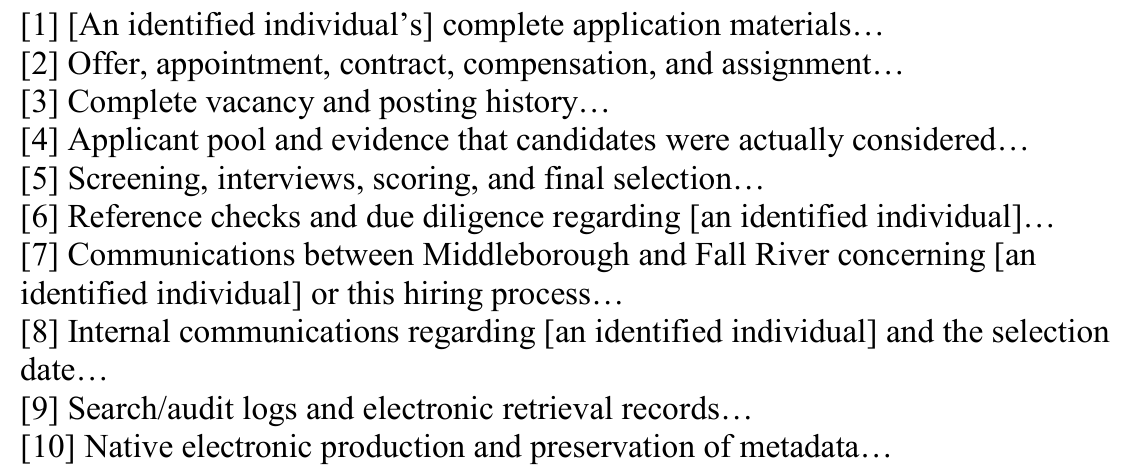
The categories covered the applicant’s complete application materials; the offer, appointment, contract, compensation, and assignment; the complete vacancy and posting history; the applicant pool and evidence candidates were actually considered; screening, interviews, scoring, and final selection; reference checks and due diligence; communications between Middleborough and Fall River concerning the candidate or the hiring process; internal communications regarding the candidate and the selection date; search and audit logs; and native electronic production with metadata preserved.
Three of them — the internal communications, the search and audit logs, and the native electronic production — are the ones the district later said it had no records for at all.
What was deliberately excluded
The exclusions matter as much as the inclusions, because they define what a fair reading of this request looks like. This was not a request designed to fish for private material and then complain about redactions. It was drafted to separate the genuinely private from the administrative.
A transcript showing specific courses taken and grades earned was not sought in the first instance. A home address was not sought. Personal contact details were not sought. Unsuccessful applicants’ identities were not sought for the sake of identifying them — a stable anonymous number was offered as sufficient. What was sought, over and over, was the shape of the process: how many people applied, how many were interviewed, how they were scored, who recommended whom, and what the district did with the answers.
The appeal that followed said this in terms, and the Supervisor of Records accepted the framing without dispute. The burden in Massachusetts public-records law sits on the custodian, not the requester. A custodian must “identify any records, categories of records or portions of records that the agency or municipality intends to withhold, and provide the specific reasons for such withholding, including the specific exemption or exemptions upon which the withholding is based.” G. L. c. 66, § 10(b)(iv).
The August 24 production
The district answered on August 24, 2026. Its response letter, signed by Records Access Officer Ann Milligan, said responsive records for requests 1 through 7 were included, and then set out three statements about what was omitted and what was absent.
What came back was fifty-three pages. Among them, on Parent Data Force’s reading of the production: a SchoolSpring application for the successful candidate; the job posting; the executed employment agreement, dated July 31, 2026, providing an annual salary of $142,000; a page stating that at least three references were contacted by individual telephone calls; interview rating forms and a scoring rubric; a page referring to a communication between the Fall River Superintendent and the Middleborough Superintendent; and a page labeled by handwriting “Superintendent notes on references,” heavily redacted.
What was redacted, on the district’s account, is stated in three sentences in the letter: personal information such as personal cell phone, email and address; information “evaluative in nature, including grades earned, details relating to recommendations received, and analysis of interview responses”; and “all individualized information about the 24 applicants who were not selected for the position,” withheld under Exemption (c).
The salary figure is worth pausing on, because it is arithmetic rather than argument. The posting advertised a maximum of $140,000. The executed contract provides $142,000. The contract separately addresses longevity and states that as of July 1, 2026 the successful candidate had zero years of administrative service in the district and would not receive longevity during the contract term, which on its face makes $142,000 the base salary rather than a posted maximum plus an increment.
“No records responsive on file”
The third sentence is the one that produced the appeal. The district wrote: “There are no responsive records on file for requests 8, 9 and 10.”
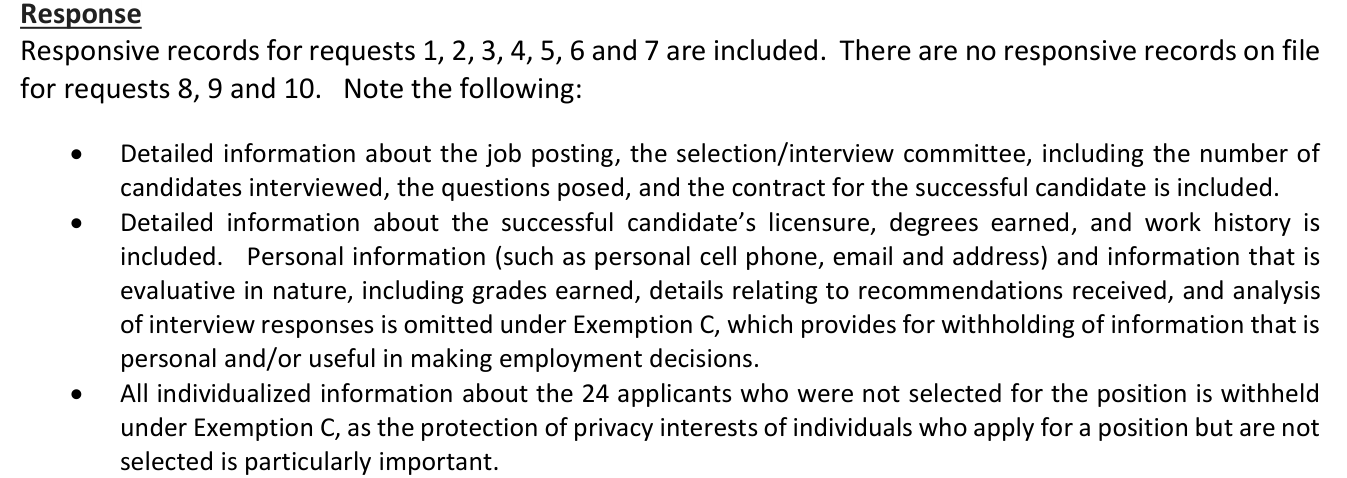
Those three items were internal communications regarding the candidate and the selection decision; search and audit logs and electronic retrieval records; and native electronic production with metadata preserved.
A blanket denial of all three, in a hiring that a parent and a public are entitled to be able to follow, is a substantial claim. It is also a claim the district made in the alternative to producing anything — and the Supervisor of Records would later treat the specificity of that explanation as a problem of its own.
The fifty-three pages
The production is the reason the Supervisor’s September 8 determination is as narrow as it is. Read against the questions asked, it left visible gaps that Parent Data Force documented in its appeal, and that documentation is Parent Data Force’s own review — not a finding by the Supervisor, and not a claim this article makes about the district’s intent.
On that review, the posting, the committee’s deliberations at 3:15 p.m. on July 21 with “at least two finalists forwarded to the Superintendent,” and the executed contract were produced, but the production contained blank interview-rating forms and a scoring rubric with no completed rating forms, evaluator scores, ranking sheets, candidate-comparison records, or finalist-transmittal records. A handwritten notation on the produced SchoolSpring application appears to read “Wed 7/29 11am #1,” with a second notation confirming 11:00 a.m.; because the committee interviews occurred July 21 and the contract was executed July 31, that may reflect a finalist-stage event, and the production contains no invitation, calendar entry, notes, or other document explaining the notation. The produced application pages are not sequential: source pages 29 through 34, 37 and 40 appear, page 39 appears later as the references page, and pages 35, 36 and 38 are unaccounted for. The district’s confidentiality forms state that candidate materials were to remain with the Committee Chair, which identifies an additional likely custodian.
Two of the gaps were answered on the record. The unaccounted-for pages turned out to be a college transcript, which the district later produced with specific courses and grades redacted. The July 29 notation turned out to correspond to second interviews with each of the two finalists, which the district attached after Parent Data Force raised the date. Neither of those answers is itself contested here. The point is narrower: the district did not surface either one on its own, in a production Parent Data Force had to audit to find.
The Fall River item is different again, and it is the one still unresolved. The production refers to a communication between the Fall River Superintendent and the Middleborough Superintendent discussing candidates’ performance and fit for Middleborough, and a handwritten page labeled “Superintendent notes on references” sits immediately after it, heavily redacted. The district’s position is that the notes are evaluative and exempt. What has not been produced is the underlying communication the production itself describes.
The appeal
On August 25, 2026, Parent Data Force appealed under G. L. c. 66, § 10A and 950 CMR 32.08(1). The appeal opened SPR26/3331, and the same day Parent Data Force filed a separate supplemental request, which would become its own appeal, SPR26/3602.
The appeal was explicit that it did not challenge lawful redaction of Social Security numbers, home addresses, personal telephone numbers, personal email addresses, medical information, or CORI information, and did not seek unsuccessful applicants’ identities for the sake of identifying them. It argued that the Exemption (c) explanation was too categorical to satisfy the specificity requirement, that the production was incomplete, and that responsive process records should have been produced in de-identified form where that was possible.
Story Two — what the Supervisor decided
The September 4 second denial
While SPR26/3331 was pending, the district answered the August 25 supplemental request on September 4, 2026, and the answer was largely a repetition of the first. The district produced some records for items 7 and 8, redacted under Exemption (c), and produced records for items 4 and 9 with “unresponsive” information redacted. For items 1, 2, 3, 5 and 6 — the $142,000 salary and how it was decided, the offer and contract transmittal, the finalist recommendation and final-selection records, the Fall River communication, and the reference-call notes — the district stated that, other than records previously provided, it had no additional responsive records.

Two things in that response are load-bearing for what follows. First, the district used the phrase “unresponsive” as though it were a basis for redaction on responsive records — calendar notations “unrelated to these interviews,” and a resignation letter whose redacted portions were called “unresponsive.” “Unresponsive” is not among the exemptions in G. L. c. 4, § 7(26). Second, the district said in terms that it withheld and continues to withhold records relating to the other applicants, “including the other finalist.” That is the sentence that later matters most, and it came from the district, not from Parent Data Force.
The September 4 letter also corrected a number. The SchoolSpring applicant-tracking printout it produced listed thirty applications rather than the twenty-five the district had cited in August, and the district apologized for the error, stating there were five additional applicants on the following page and that all were reviewed.
Two appeals
The matter now spans three dockets, and keeping them straight is worth a moment because each one decided something different.
- SPR26/3331 — the appeal of the August 24 response, plus a narrow reconsideration of the September 8 determination on G. L. c. 66, § 3A.
- SPR26/3602 — the appeal of the September 4 response to the August 25 supplemental request. Determined September 22, 2026.
- SPR26/3939 — the appeal of the September 22 response, opened September 22, 2026. Open, undetermined.
SPR26/3331 and SPR26/3602 both carry determinations. The district’s response to the September 29 reconsideration order is not in the record as of this writing, and the ten-business-day clock in that order has not been shown to have run to a conclusion. SPR26/3939 remains open.
September 8: the address
The first determination, issued September 8, 2026 in SPR26/3331, was not a clean sweep for the requester, and reporting it as one would be wrong.
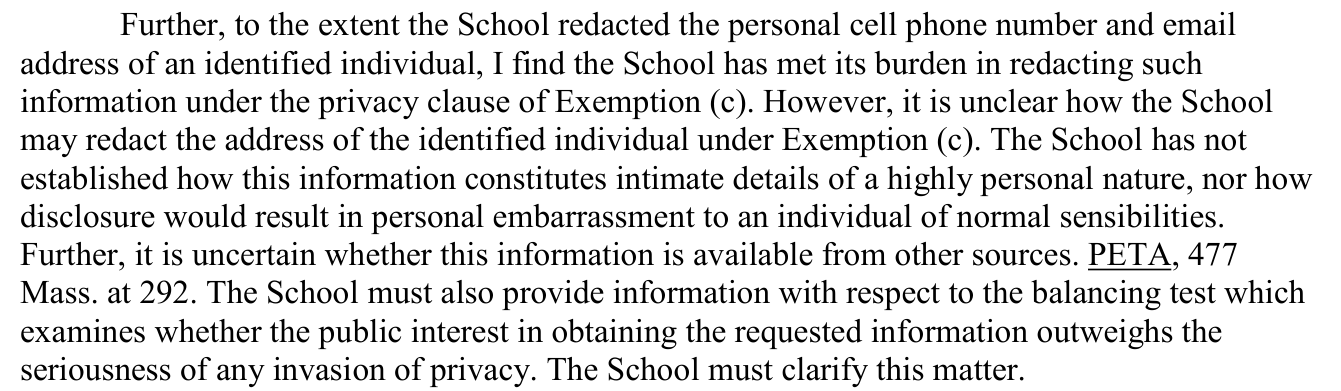
On the successful candidate’s personal information, the Supervisor split the difference. The district had redacted a personal cell phone number and an email address; the Supervisor found the district “has met its burden in redacting such information under the privacy clause of Exemption (c).” The address was different. The district had not established how a home address constitutes intimate details of a highly personal nature, nor how disclosure would result in personal embarrassment to a person of normal sensibilities, and it was uncertain whether the information was available from other sources. Under the second clause of Exemption (c) the analysis is a balancing test, and the district had not supplied the balancing.
September 8: the twenty-four unsuccessful applicants
The second holding is the larger one, and it goes to the applicants rather than to the successful candidate. The district had withheld “all individualized information about the 24 applicants who were not selected for the position.” The Supervisor found the district “has not met its burden to withhold entirely” that information.
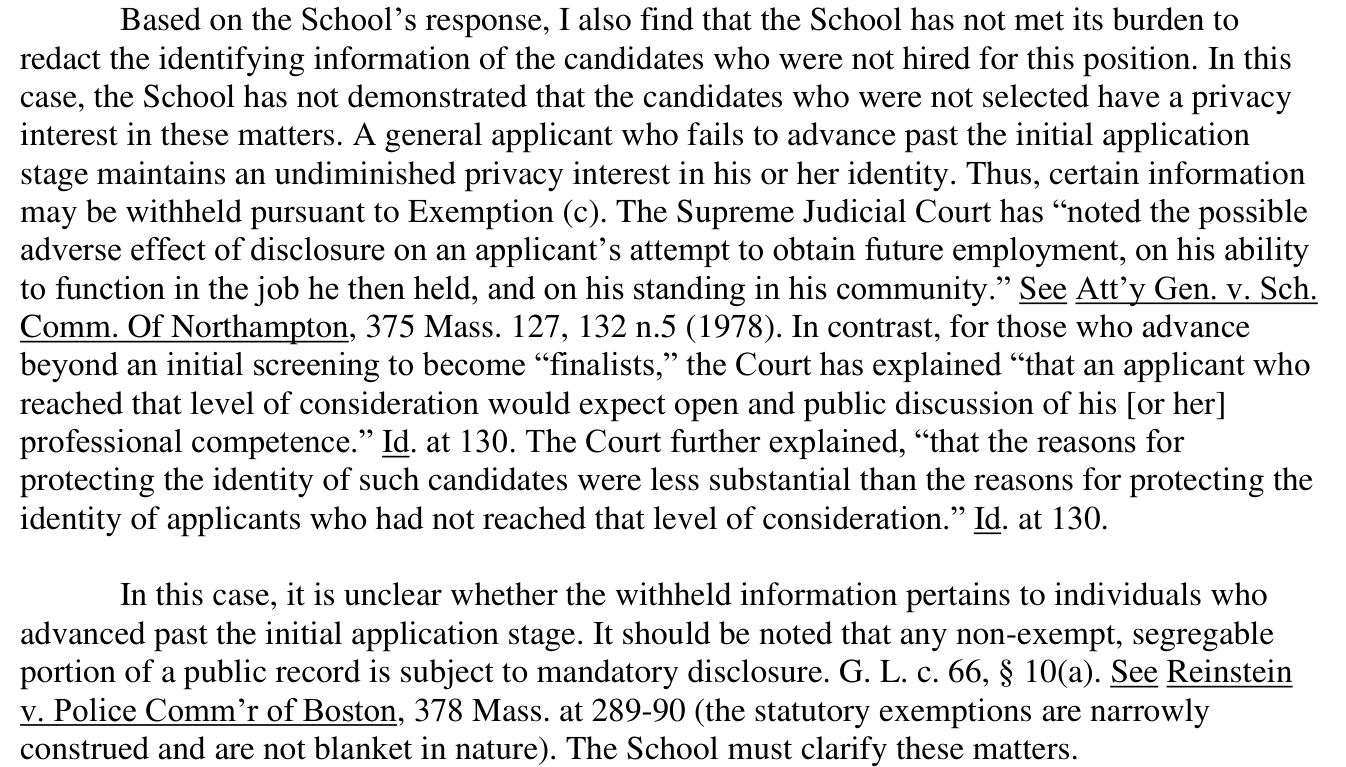
The reasoning is the part that matters. A general applicant who fails to advance past the initial application stage does maintain an undiminished privacy interest in their identity, and some information about those applicants may properly be withheld. But the Supreme Judicial Court has explained that an applicant who reached finalist status “would expect open and public discussion of his [or her] professional competence,” and that “the reasons for protecting the identity of such candidates were less substantial than the reasons for protecting the identity of applicants who had not reached that level of consideration.” Attorney General v. School Committee of Northampton, 375 Mass. 127, 130 (1978).
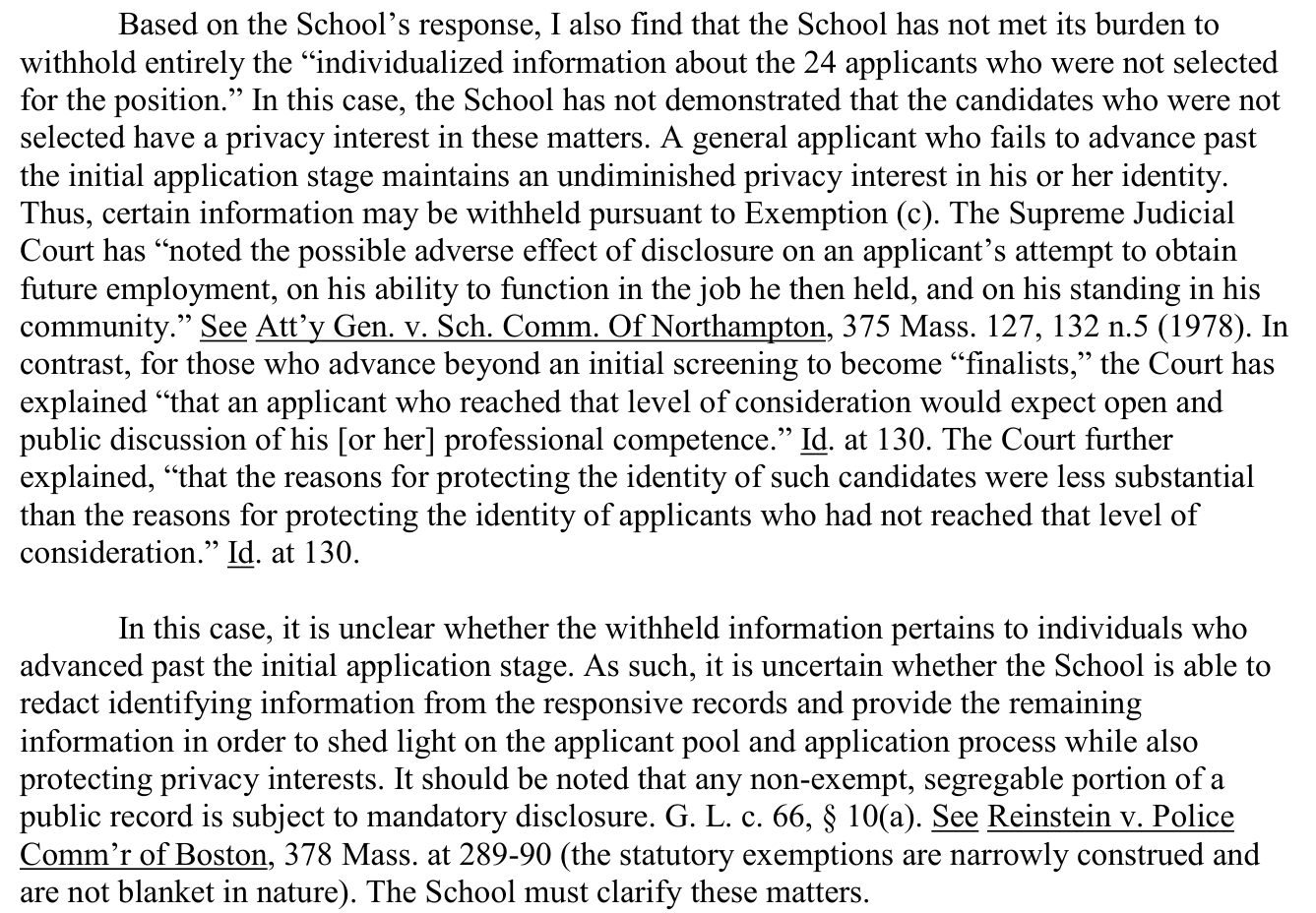
The district’s response had been that the privacy interests of people who apply but are not selected “are particularly important.” The Supervisor’s answer was that the district had not shown which applicants those were. The holding is not that every unsuccessful applicant’s identity must be disclosed. It is that a blanket withholding of all individualized information about all 24 fails, because the district never established whether the withheld material includes people who advanced past initial screening — and the exemptions are “narrowly construed and are not blanket in nature.” Reinstein v. Police Commissioner of Boston, 378 Mass. at 289–90.
What the September 8 order actually did
This is the point at which summaries of this case most often go wrong, so it is worth stating plainly.
The September 8 determination did not order the district to release the applicant’s address, or the applicant-pool records, or anything else. It ordered the district to provide a response to the request, “provided in a manner consistent with this order, the Public Records Law, and its Regulations,” within ten (10) business days, with a copy to the Public Records Division. The district was given a chance to explain the address redaction, to say which applicants were actually finalists, to segregate the identifying information from the rest, and to say whether additional responsive records exist.
That is a clarification order, not a disclosure order. As of this writing, nothing has been produced under it, and it is not known whether the district’s ten-business-day response has been filed.
September 8: the additional-records question
The same determination raised a third question, which is easy to overlook because it is procedural. Based on the appeal petition and the district’s response, the Supervisor found it “unclear whether the School possesses any additional records responsive to the request, other than those provided or withheld under Exemption (c)” — specifically, the records Parent Data Force’s appeal claimed had not been addressed at all. The Supervisor ordered the district to clarify whether it possesses any of them, and, to the extent they exist, to provide them or identify an exemption that applies.
The duty to comply extends to records that exist and are in the possession, custody, or control of the custodian at the time of the request. G. L. c. 66, § 10(a)(ii). A custodian cannot answer a records question by describing the set of documents it chose to collect.
SPR26/3602
Six days after the SPR26/3602 appeal was acknowledged, and two weeks after the September 4 second denial, the Supervisor decided the second docket on September 22, 2026. It is a separate appeal of a separate response, but it is decided on overlapping ground, and it reaches the same conclusion on the same point.
On the applicant-tracking report produced for item 8, the district said the names of those who applied but were not appointed “are redacted, as their privacy interests are protected under Exemption C.” On review, the Supervisor found the redacted columns were not only name but “residence” and “degree” of the applicants. As with the address, the district had not established intimate detail or personal embarrassment, and had not supplied the balancing.
Then came the finalist holding again, in terms nearly identical to September 8: the district “has not met its burden to redact the identifying information of the candidates who were not hired for this position.”
The SPR26/3602 determination added two further criticisms. Calling material “unresponsive” is not an exemption, and the district had not identified which exemption it was relying on to redact responsive records. And the district’s stated inability to produce native electronic records because they required redaction was, in the Supervisor’s view, a consequence of the redactions rather than a reason for them: to the extent the district must redact, it is not feasible to provide those records in the requestor’s preferred format.
The determination also declined to decide anything already decided in SPR26/3331, noting that the district’s September 4 response and Parent Data Force’s appeal both reached back to records addressed in the first appeal, and that a second determination on those issues was not available. It ordered a response within ten (10) business days, on the same terms as before.
The September 22 response
The district answered SPR26/3331 on September 22, 2026. The response, signed by counsel for the district, took two positions worth reporting as positions rather than as findings.
The first is factual and was not previously in the record. The district confirmed that the person whose identity it continues to withhold is the finalist who was not appointed.
The second is legal. The district argued that the Northampton finalist analysis should not transfer from a superintendent search to a principal search, on the footing that the Open Meeting Law’s treatment of executive-session material for superintendent candidates does not carry over to a principal appointment. Parent Data Force’s assessment, in its September 23 supplemental submission to the open docket, is that the distinction does not hold here — SPR26/3602 applies the Northampton finalist framework to this very principal search, and the district has now supplied the fact that was missing on September 8 and September 22, namely that the withheld person reached finalist stage.
The district corrected and re-sent that response on the night of September 22. The corrected copy is the one in the record used for this article, not the original.
September 29: § 3A
On September 8, 2026 — the same day as the first determination — Parent Data Force requested narrow reconsideration, limited to one question. The September 8 determination had approved the redaction of “details relating to recommendations received” under the personnel clause of Exemption (c). The request asked whether that was intended to authorize withholding external recommendations submitted in support of the successful candidate, for the position he was ultimately hired into.
The answer on September 29 quotes the statute in full.
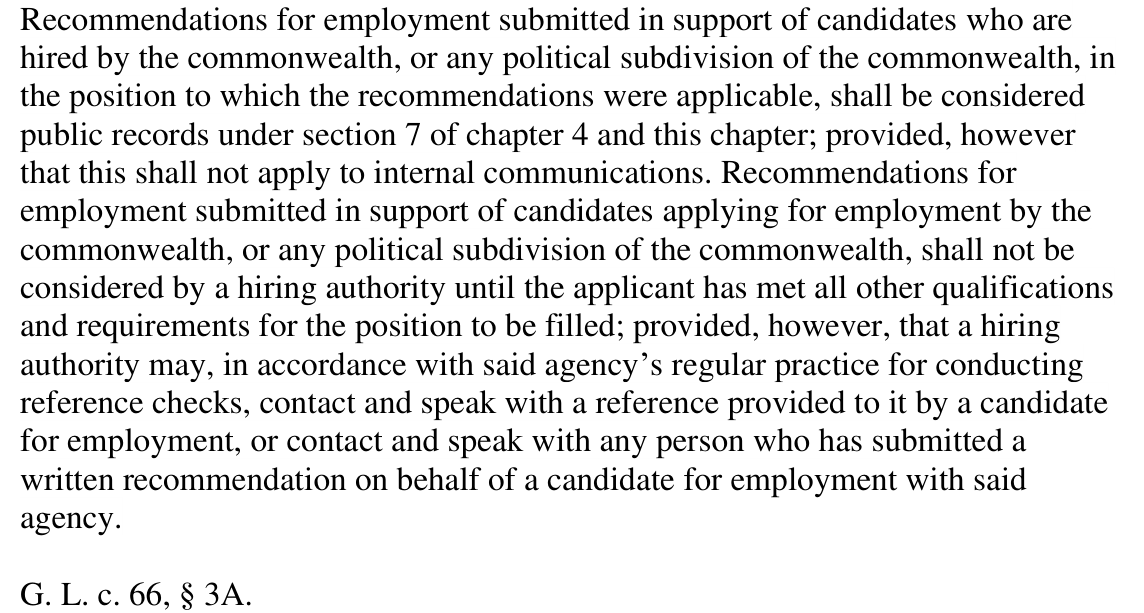
The operative sentence is the first one: recommendations for employment submitted in support of candidates who are hired, in the position to which the recommendations were applicable, “shall be considered public records.” The statute carves out internal communications, and it says nothing that on its face exempts external recommendation letters.
The statute’s application to this search is direct. The successful candidate was hired, into the position the recommendations supported. If the August 24 production contains external recommendation letters submitted in support of him for the Middleborough principal position — and Parent Data Force’s September 5 submission says it does, including letters originating outside the district — then § 3A addresses their status after he was hired.
September 29: what the district must now confirm
What the September 29 determination ordered is worth stating exactly, because it is a clarification order and not a disclosure order.
The Supervisor again held that grades earned and analysis of interview responses are properly redactable under the personnel clause of Exemption (c), and said so plainly. But as to “details relating to recommendations received,” the School must clarify whether that withheld information is the type contemplated under G. L. c. 66, § 3A. In order to withhold it, the district “must confirm that any withheld portions of these referenced records do not constitute public records as prescribed by G. L. c. 66, § 3A” — specifically, must confirm that they do not constitute recommendations submitted in support of a candidate who was hired into the position to which they apply, and are not internal communications.
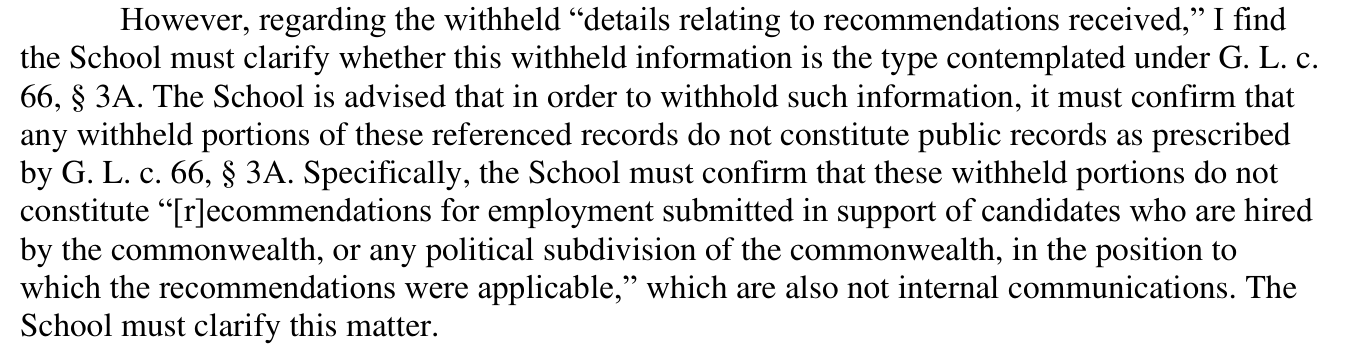
So the September 29 order is a confirmation order, within ten (10) business days, on the same terms as the two before it. It does not itself release the recommendation letters. It requires the district to say, on the record, that what it is withholding is not something § 3A makes public. If the district can say that, the redaction stands. If it cannot, the redaction fails — and that consequence has not arrived yet.
The district’s § 3A response is not in the record as of this writing.
SPR26/3939, open
The third docket, SPR26/3939, was opened September 22, 2026 on the appeal of the September 22 response, and it remains open. It covers the district’s reasoning about the withheld finalist’s identity, the principal-versus-superintendent distinction, and the currency of the response given the determination two days earlier.
Parent Data Force filed a supplemental submission on September 23 putting the SPR26/3602 holding before that docket, and on the same day wrote separately to the district’s counsel asking whether the September 22 determination changes the district’s position on withholding the unsuccessful finalist’s identity. Both are filings. Neither is a ruling, and the docket has produced no determination.
What the record establishes
Stated plainly, and limited to what the Supervisor of Records has actually decided:
- The district did not meet its burden to redact the successful candidate’s address. The privacy clause of Exemption (c) does not justify it on the record the district gave, and the district has not supplied the balancing the clause requires. September 8, SPR26/3331.
- The district did not meet its burden to withhold all individualized information about the 24 unsuccessful applicants. September 8, SPR26/3331.
- The same analysis was applied to the same search in the second docket. The district did not meet its burden to redact the identifying information of candidates who were not hired. September 22, SPR26/3602.
- The Supervisor upheld the district’s other redactions. Grades earned and analysis of interview responses may be redacted under the personnel clause of Exemption (c). A personal cell phone number and email address may be redacted under the privacy clause. September 8, SPR26/3331; repeated September 29.
- “Unresponsive” is not an exemption. The district had to identify which exemption it relied on to redact the responsive material it called unresponsive. September 22, SPR26/3602.
- The district must now address § 3A. Recommendations submitted in support of a candidate who was hired, for the position to which they apply, are public records unless they are internal communications, and the district must confirm that its withheld recommendation material is neither. September 29, SPR26/3331.
- The district confirmed the withheld person was the other finalist. That confirmation is the district’s own, in its September 22, 2026 response.
What the record does not establish
- Nothing has been produced under either order. The September 8 and September 29 determinations ordered a response within ten business days. They did not order production, and no responsive record has been released as a result of either. The September 22 determination in SPR26/3602 is a third such order.
- The district’s § 3A response is not in the record. It was due within ten business days of September 29. What it says, or whether it was filed, is not known here.
- The successful candidate’s identity is still being withheld. The Supervisor anonymizes him. The district continues to withhold him. The September 23 request to counsel is a request, unanswered in the record.
- The address and applicant-pool records have not been released. The Supervisor found the redactions unjustified as articulated; the district has not yet shown why they are justified, and may yet.
- Nobody has ruled that the district’s search was incomplete. The Supervisor found the additional-records question unclear and ordered clarification. She has not found that records are missing, and this article does not assert that they are.
- The district’s principal-versus-superintendent distinction is unresolved. It is the district’s argument; no determination has sustained or rejected it.
- The Fall River communication has not been produced. The production refers to it. The underlying record has not been produced, and no determination has ordered it.
What remains open
- The district’s § 3A response, due within ten business days of September 29, 2026. It has to confirm on the record that its withheld recommendation material is not § 3A public records.
- Any determination in SPR26/3939, opened September 22 and undetermined.
- Whether the address and the applicant-pool records are released, and in what form — segregated, anonymized, or otherwise. Both of the first two determinations are clarification orders, and the record does not yet show what the district will say in response.
- Whether the district identifies the applicants who advanced past initial screening, which is the specific fact the Supervisor said it needed on both September 8 and September 22.
- Whether the Fall River communication is ever produced, and whether the redacted “Superintendent notes on references” are ever segregated rather than withheld whole.
- Whether the applicant’s identity is released, which now turns on a district that has itself confirmed finalist status.
The full record, the exhibits and the chronology are collected at the Middleborough Principal-Hiring Records Project. Every exhibit in this article is a clean crop of the source document itself. The determinations behind them are crop sources for this project and are not offered as downloads.
If you have documents from this matter — a district response, a determination, a filing — or you would like to be notified when the district answers the § 3A order, or when SPR26/3939 is decided, write to joey@parentdataforce.com. Other Parent Data Force records projects, including the Worcester Cybersecurity Records Project and the Massachusetts Student Settlement Records Project, are tracked separately on the projects index.
Leave a Reply
You must be logged in to post a comment.