
East Bridgewater produced thirteen PDFs and 2,243 pages of district email. A state supervisor accepted some of the redactions, refused to accept the rest, and closed the missing-record question on a procedural ground rather than a finding. That distinction is the whole story.
East Bridgewater Public Schools did something unusual in the summer of 2026. It answered a public records request with volume. Thirteen PDFs, 2,243 pages, delivered by secure link on July 27 — a production large enough to end most records disputes on the spot, because the requester usually has to pay before the records become readable and usually cannot afford to.
This dispute did not end. It sharpened.
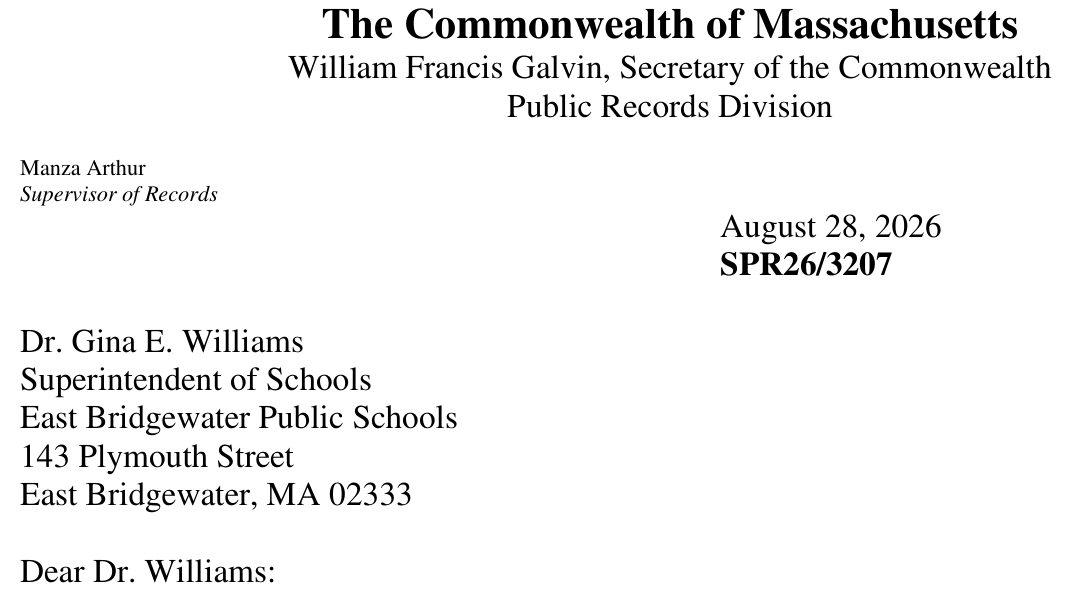
The Massachusetts Supervisor of Records issued a determination on August 28, 2026 in docket SPR26/3207 that upheld some of East Bridgewater’s redactions, refused to bless the rest, and resolved the question of a missing record without ever deciding whether the record existed. Each of those three results is narrower than the headline and more specific than the summary. This article is about what the determination actually said, what it did not say, and what remains open on the record as of October 1, 2026.
A note on what this article does and does not claim. It reports a public-records proceeding. It does not assert that East Bridgewater withheld records unlawfully, that any student record was disclosed improperly, or that the redactions were improper as a whole. Two of those questions are live and unresolved. Where the record is silent, this article says so rather than filling the gap.
The request that started all of it
On April 27, 2026, Parent Data Force sent East Bridgewater Public Schools an amended public records request for all emails sent to or from any district-controlled email account — addresses, aliases, shared mailboxes, distribution lists, Google Groups, administrative and archived accounts — in which the word “stapler” appeared in either the subject line or the body.
The date range ran from April 27, 2023 through the date the request was searched and processed. It covered the district’s known domains, including its high school, middle school, and elementary school subdomains, and any Google Workspace, Microsoft 365, or school-specific domain used by district staff. For each responsive message, the request asked for the complete thread, including messages that did not themselves contain the word.
That last clause is where the later trouble starts. A thread is only as reviewable as its attachments and its context. A request for whole threads invites a response containing whole threads, redactions, and attachments — and it is the attachments, in this case, that became a separate fight.
The determination quotes the request at length precisely because its scope matters to the holding. This was not an unlimited demand. It named a keyword, a date range, and a set of accounts.
What came back, and when
The District’s account of its own response, as recited in the determination and the underlying correspondence, is a sequence worth stating exactly:
- May 14, 2026. The District stated it had located hundreds of emails that may be responsive, asked whether the requester would agree to an extension to May 29, and noted the search had returned both staff and student emails — asking whether staff-only was intended.
- On or about May 28, 2026. Records were produced. The production included email materials and .pst files inside a zip archive.
- June 2, 2026. The District wrote that confidential personnel documents “may have been inadvertently disclosed,” stated its understanding that a letter from an employee to the School Committee dated February 2025 may have been received, said that document “should have been withheld and/or redacted,” and asked the requester to delete and destroy it.
- June 15, 2026. The District’s revised written response, citing Exemption (a) and FERPA. The District later offered to mail the documents or make them available for pickup.
- July 27, 2026. The District supplied a Google Drive link to the electronic production: thirteen PDFs, 2,243 pages, File 1 through File 13, with the June 15 exemptions restated as “remain applicable.”
- August 4, 2026. Determination in SPR26/2791, the first appeal, ordering the School to clarify how the redactions could be withheld under FERPA through Exemption (a) and to clarify whether any additional records existed.
- August 17, 2026. The School responded. Four separate appeals followed from that one response: SPR26/3203, SPR26/3207, SPR26/3208, and SPR26/3220.
- August 28, 2026. The determination at issue here.
The production arrived in two installments — in part on May 29 and further on July 27 — which is the District’s own characterization, quoted in the determination.
What the District said it had, and had not, withheld
The District’s August 17 position is quoted in full on page two of the determination. It is the sentence the Supervisor later relied on to close one branch of the appeal, so it is worth reading exactly rather than in summary:
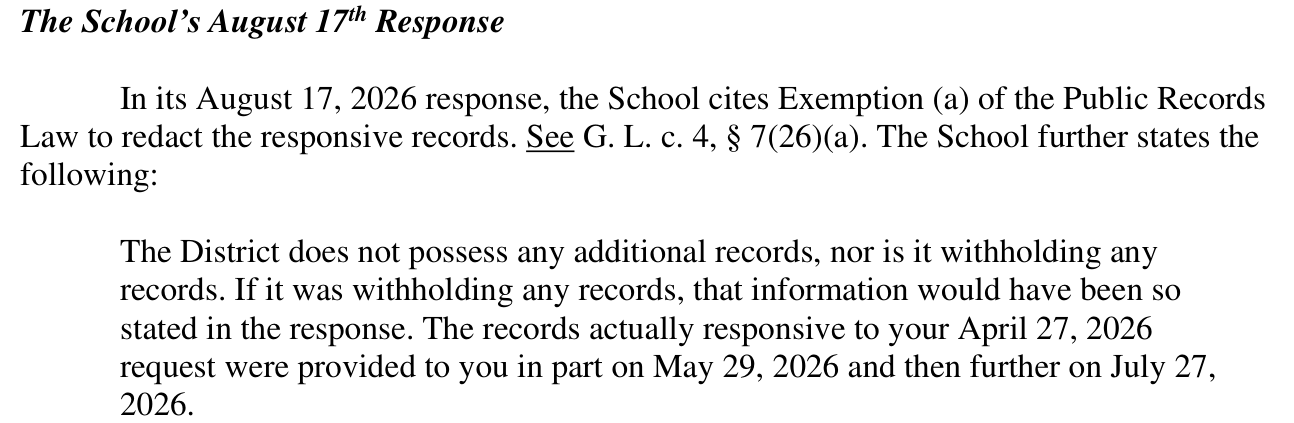
Note the structure of that statement. It makes two claims: that nothing additional is possessed, and that nothing is being withheld. It then adds a supporting argument — that if records were being withheld, the District would have said so in the response.
That last clause is doing quiet work. It reasons from the absence of a statement to the absence of withholding. It is a statement about the District’s own disclosure, not an independent fact about what exists in its systems.
What the appeal actually contested
The determination reproduces the requester’s appeal position on page three, and it is more specific than a summary of “challenged redactions” would suggest. Three concrete issues were raised:
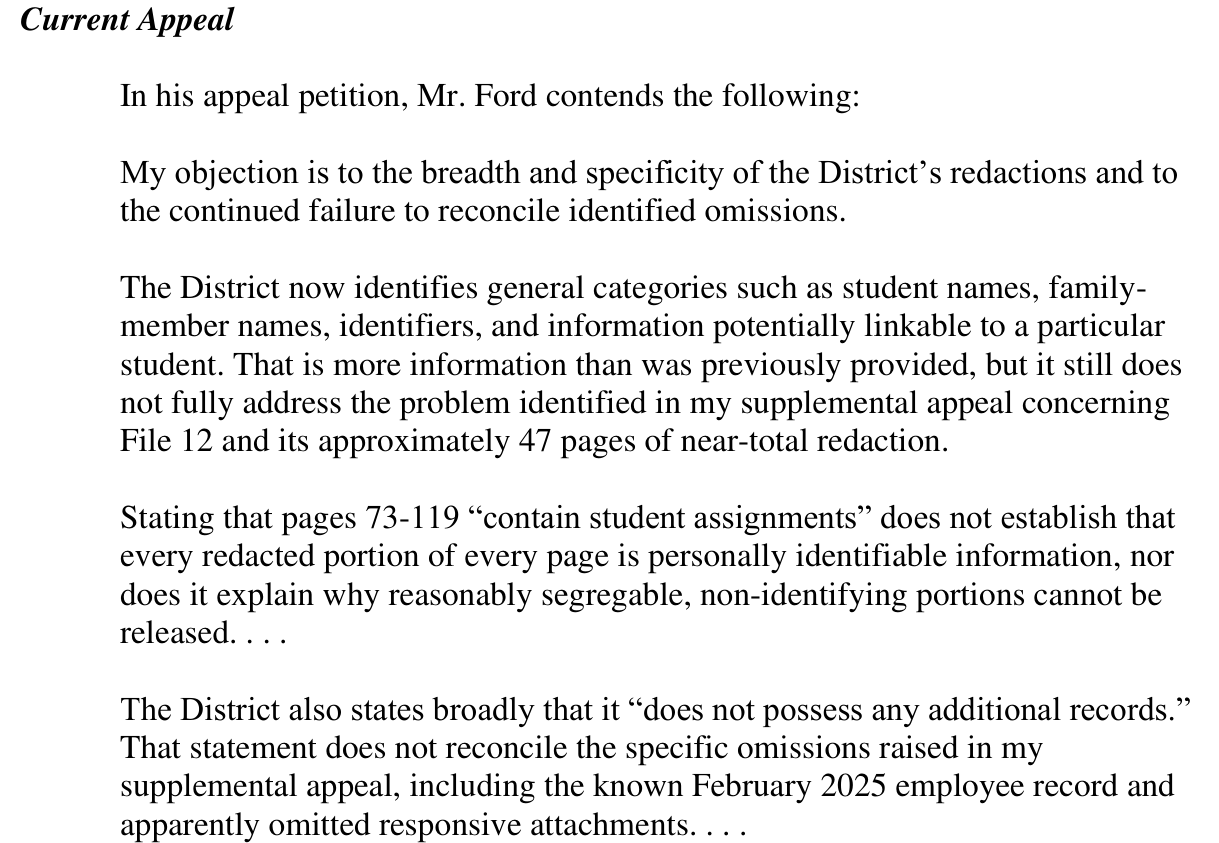
The “approximately 47 pages” figure belongs to the appeal, not to a finding. The determination repeats it as the subject of the appeal. Those 47 pages are the run of near-black pages in File 12 — pages 73 through 119 — described in the July 28 supplemental filing as almost entirely blacked out, with page 73 revealing only part of an email header and page 120 abruptly returning to unrelated content.
Pages 73 through 119 is a 47-page range. The arithmetic is consistent. That consistency is worth stating because it is the kind of detail that is easy to assert loosely and hard to check — this one checks out.
The decision: upheld in part, explain more
The holding is on page five, and it is two sentences with a hinge in the middle:
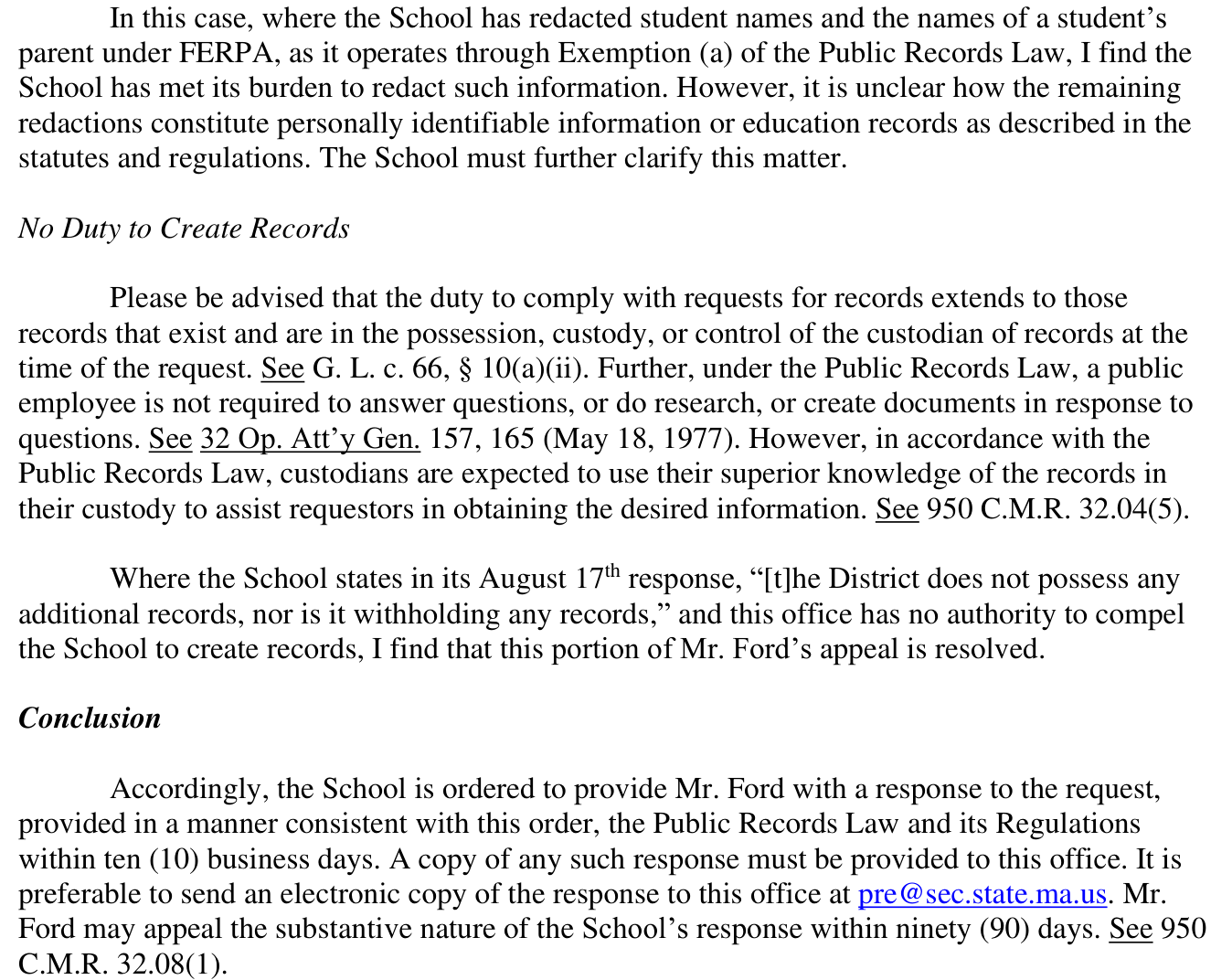
Restated in plain terms, the determination does four things:
- Upholds the redaction of student names and the names of students’ parents under FERPA, operating through Exemption (a). The Supervisor found the School “has met its burden to redact such information,” and observed that redactions ahead of email addresses or within email communications are “fairly straightforward” to see as identity-preserving.
- Declines to uphold the rest. It is “unclear how the remaining redactions constitute personally identifiable information or education records as described in the statutes and regulations.” The School “must further clarify this matter.”
- Resolves the missing-record issue procedurally, not on the merits — addressed below, because this is the part most often flattened.
- Orders a response within ten business days, with a copy to the office, and preserves the right to appeal the substantive nature of that response within ninety days.
The middle item is the live one. The Supervisor accepted the identity redactions and stopped there. The remaining redactions were neither approved nor condemned; they were sent back for explanation. Under the specificity requirement quoted in the determination, a custodian “must not only cite an exemption, but must also state why the exemption applies to the withheld or redacted portion.” The District had cited Exemption (a) and listed four categories. The Supervisor found that sufficient for names and insufficient for the remainder.
What “resolved” does not mean here
The determination’s treatment of the missing-record question is the single most important thing to read precisely, because it is the easiest to misreport in either direction.
The District had said it does not possess additional records and is not withholding any. The Supervisor addressed the objection to that statement, reasoning from the Public Records Law’s limits: a public employee “is not required to answer questions, or do research, or create documents in response to questions.” Because the office has no authority to compel the creation of records, the Supervisor wrote, “I find that this portion of Mr. Ford’s appeal is resolved.”
Three things follow, and all three matter:
- No finding was made that no record was withheld. The Supervisor found the objection unresolvable by that office on the record before it, not that the objection was wrong.
- No finding was made that the District’s statement was accurate. The determination did not test it. It accepted it as the District’s position and explained why the office could not go further.
- The determination preserved the rest of the appeal. The redaction-clarification issue was sent back, and the ninety-day appeal window on the eventual response was expressly preserved.
A determination that closes an issue procedurally is not a merits ruling. It means the forum could not reach the question on the record before it. Anyone reading “the missing-record claim was rejected” is reading something the determination does not say.
The District answered, on the deadline
The determination was issued Friday, August 28, 2026 and ordered a response within ten business days. Labor Day fell on Monday, September 7. Counting that state holiday, the tenth business day was Monday, September 14, 2026.
On September 14, 2026, Superintendent Gina Williams sent a letter captioned RE: SPR26/3207, SPR26/3203, copying the Supervisor, with the attachment “J. Ford Supplemental Request 9.14.26.pdf.” It arrived on the last day the order allowed.
What the letter says about the redactions is direct. It accepts that the appeal concerns “pages 73-119 and why these records are redacted in full,” and states that “these documents constitute student work/assignments in their entirety and were prepared by students,” and that “any less redacting of these documents would subject the District to liability for disclosing student record information because it does not have authorization to release these assignments.”
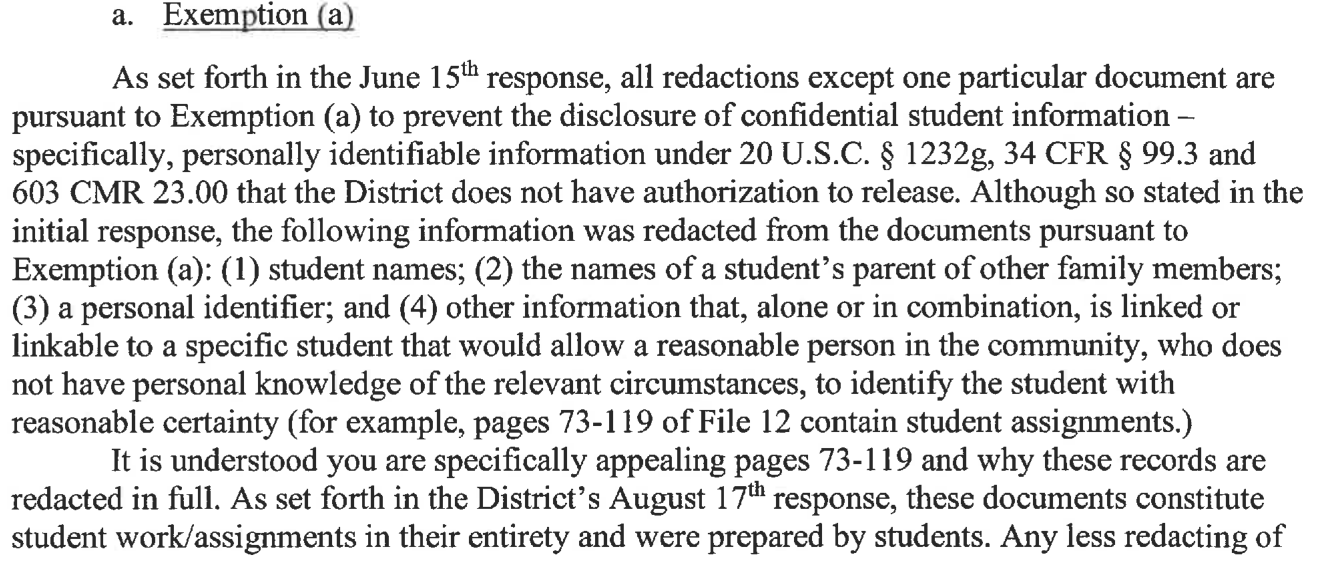
So the District has now stated its position on the record, in writing, twice: first that pages 73-119 contain student assignments, then that they constitute student work “in their entirety,” that they were prepared by students, and that no lesser redaction is possible without exposing the District to liability.
The Supervisor has not yet ruled on that September 14 letter. As of October 1, 2026 no determination post-dating it appears in the docket.
The parallel dockets nobody should confuse with this one
The August 17 response generated four appeals, all involving the same District and related underlying searches. Only one of them is about the 2,243-page production. Mixing them up is the easiest error to make when summarizing this matter, so they are separated here:
- SPR26/3207 — the redactions in the 2,243-page production, and the missing-record question. This article’s subject. Determined August 28, 2026.
- SPR26/3203 — whether the District possesses records showing the transmission of a specific June 3, 2026 email and its attachment, in native format with metadata. Determined August 31, 2026. The September 14 letter also answered this docket, stating that no other responsive records exist “including but not limited to metadata.”
- SPR26/3208 — the District’s search, review, and production conduct, and Exemption (c) and attorney-client privilege claims over 17 documents. Determined August 31, 2026. The Supervisor ordered the unredacted records submitted for in camera inspection, and the District submitted them on September 11, 2026. The office confirmed receipt and set a decision due fifteen business days from that receipt. No outcome had issued as of October 1, 2026.
- SPR26/3220 — a further appeal from the same August 17 response. Determined August 31, 2026.
The in camera submission is the most procedurally interesting development in the file, and it is easy to miss: on one branch of this dispute, the unredacted records are now with the Supervisor, unreleased by design. The Public Records Division states it does not release in camera records to anyone under any circumstances, so this is not a disclosure event. It is a review event, and the review’s output is a determination that has not yet been issued.
What the record establishes
These are findings or direct quotes, not interpretations:
- East Bridgewater produced 13 PDFs totaling 2,243 pages on July 27, 2026, after a partial production around May 28–29.
- The District invoked Exemption (a) and FERPA to redact the responsive records, citing four categories: student names; names of a student’s parent or other family members; a personal identifier; and information linkable to a specific student such that a reasonable person in the community could identify the student with reasonable certainty.
- The District stated on August 17, 2026 that it does not possess any additional records and is not withholding any records.
- The Supervisor found the School met its burden to redact student names and parents’ names under FERPA through Exemption (a).
- The Supervisor found it unclear how the remaining redactions constitute personally identifiable information or education records, and ordered the School to clarify.
- The Supervisor found the missing-record portion of the appeal resolved, on the ground that the office cannot compel the creation of records.
- The School was ordered to respond within ten business days, and the requester retained a ninety-day right to appeal that response.
- The District responded on September 14, 2026, asserting that pages 73-119 of File 12 constitute student work in their entirety and cannot be redacted any less.
- The District submitted records for in camera inspection in SPR26/3208 on September 11, 2026, and a decision on that submission was due fifteen business days later.
What the record does not establish
Stated explicitly, because each of these is a common overreach:
- It does not establish that all redactions were improper. The determination upheld the name redactions and declined to rule on the others. Neither a clean sweep nor a clean bill.
- It does not establish that the remaining redactions are lawful. The finding is that they were not adequately explained. Unexplained is not the same as upheld, and it is not the same as unlawful.
- It does not establish that a record was withheld. The missing-record issue was closed procedurally. No one found that East Bridgewater was withholding anything.
- It does not establish that the District’s “no additional records” statement is true. The determination accepted the statement as the District’s position and explained why the office could not test it. That is not verification.
- It does not establish that the September 14 letter is correct. It is the District’s assertion. The Supervisor has not ruled on it.
- It does not establish that any student record was disclosed unlawfully. The District asked the requester to delete and destroy the February 2025 letter on June 2, 2026. Whether the original production contained material the District lacked authorization to release is a contested question that no determination has decided.
- It does not establish that pages 73-119 are the only heavily redacted pages. The Supervisor ordered clarification of “the remaining redactions” generally. The September 14 letter addresses the pages 73-119 example specifically.
- It does not establish what the in camera review will find. Those records are unreleased by operation of the process that received them.
What can reasonably be assumed
The tier below is inference, not finding. Each is a reasonable reading, labelled as an assumption because it is one.
- The remaining redactions probably exceed the identity redactions. The Supervisor found names fair to redact and everything else unclear. A district that had confined itself to names would not have drawn a clarification order. This is an inference from the shape of the ruling, not a count.
- The 47 pages are probably genuinely student work. The District has now asserted this twice in writing and has a privacy interest in being right. That is not proof, and the Supervisor has not accepted it, but a bald claim unsupported by any record-specific explanation would be unusual from a district facing an order.
- The September 14 letter probably was written to close the clarification order rather than to open a negotiation. It is captioned to two dockets, answers both in the same structure, and restates the June 15 categories before defending pages 73-119. The District appears to regard the matter as answered.
- The in camera submission probably concerns Exemption (c) and privilege claims, not FERPA. The order in SPR26/3208 concerns the 17 documents redacted under Exemption (c) and attorney-client privilege. FERPA redactions in the 3207 production are a separate track.
- The February 2025 record probably exists in some form the District could locate. The District itself identified it in writing on June 2, 2026 and asked for its destruction. A district does not usually write to a requester about a document it cannot find. That is an inference about the record’s probable existence, not a finding that it was withheld or improperly disclosed.
None of the above is a finding, and none should be cited as one.
Open questions
What remains unresolved as of October 1, 2026, stated so that it can be tracked:
- No ruling on the September 14 letter. The Supervisor has not accepted or rejected the District’s account of pages 73-119.
- No ruling on the remaining redactions. The clarification order is unanswered as a determination, whatever the September 14 letter argued.
- No in camera outcome. Records were submitted September 11, 2026 in SPR26/3208; the decision was due fifteen business days later, which falls after this article’s publication. The Public Records Division does not release in camera records, so a favorable outcome would still not produce public disclosure of the records themselves.
- The February 2025 School Committee letter is unaddressed in the September 14 letter. The letter is captioned to SPR26/3207 and SPR26/3203 and answers both, and it states the District holds no other responsive records — but it does not mention the February 2025 record identified in the August 28 supplemental submission. This is discussed in the companion article on the blackout.
- The omitted attachments are unaddressed. The appeal identified attachment filenames shown without the attachments themselves, in Files 5, 6, 9, and 10. No filing after September 14 addresses them.
- Whether pages outside 73-119 remain near-total redacted is unknown.
Sources
This article is built from the primary record. The exhibits above are unaltered crops of the documents themselves.
- Determination in SPR26/3207, East Bridgewater Public Schools, August 28, 2026 (exhibits 01–04).
- East Bridgewater Public Schools supplemental response captioned RE: SPR26/3207, SPR26/3203, September 14, 2026 (exhibit 05).
- Determination in SPR26/2791, August 4, 2026.
- Determination in SPR26/3203, August 31, 2026.
- Determination in SPR26/3208, August 31, 2026, including the order for in camera inspection.
- Determination in SPR26/3220, August 31, 2026.
- Amended public records request of April 27, 2026 and the District’s responses of May 14, June 2, June 15, July 27, and August 17, 2026.
- Parent Data Force’s supplemental appeal and request for in camera review, July 28, 2026.
- Parent Data Force’s supplemental submission regarding the identified missing February 2025 record, August 28, 2026.
This matter is documented in full, with the source exhibits, at the East Bridgewater Public Schools Public Records Project. The blackout and the missing February 2025 record are examined separately in East Bridgewater’s 47-Page Blackout and the Record the District Says It Does Not Have. A separate, later records fight over a $350 fee estimate is covered in East Bridgewater’s Second Fee Dispute. Other Parent Data Force records projects are listed at the projects index.
If you have documents from this matter — an East Bridgewater response, a determination, a filing — or you would like to be notified when the Supervisor rules on the September 14 letter or issues the in camera determination, write to joey@parentdataforce.com. Records held by a district are public whether or not anyone asks for them, and the asking is the part that is worth doing.
Leave a Reply
You must be logged in to post a comment.